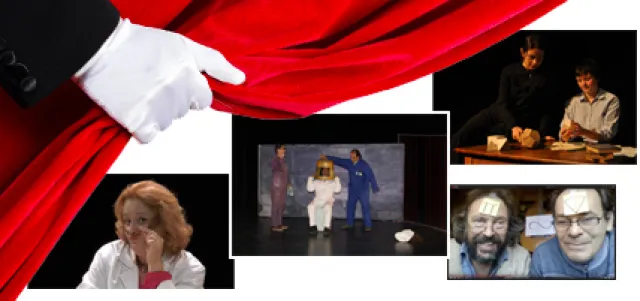
Theatre is a place, an art and a practice. A play is a text that, to truly exist, must be embodied, staged and performed before an audience. As director Ariane Mnouchkine puts it: "It keeps a small flame burning in certain hearts, in certain eyes and in certain darknesses. And it serves to tell true stories." Mathematics, by contrast, is often perceived as disembodied, abstract and immaterial… but is it really?
When maths comes to life
---------------------------
When we think of mathematics being "embodied", we often think of telling the stories of mathematicians; some biographies have a dramatic dimension that readily inspires playwrights. Examples include Benoît Solès's La Machine de Turing, which premiered in 2018 (see box) and won four Molière Awards in 2019; Geneviève Billette's Contre le temps : acte de résistance, a 2011 play featuring Évariste Galois as its main character; and Anne Rougée's Les Femmes de génies sont rares ? (2011), which portrays Marie Curie, Ada Lovelace and Émilie du Chatelet.
Theatrical fiction allows some licence with a strictly historical account, while staging and performance can convey things that might not necessarily be put into words. Alan Turing's homosexuality, Évariste Galois's political activism and Ada Lovelace's personal doubts all contribute to the drama, turning these scientists into characters with whom audiences can identify with, become interested in and grow attached to. Beyond the great figures in the history of mathematics, we also sometimes encounter characters whose work is more or less closely connected with the subject: Jeanne, for example, teaches graph theory in Wajdi Mouawad's play Incendies (2003). Both aspects recur in Apologie d’un mathématicien (Complicite, 2007), which centres on Srinivasa Ramanujan. Several plots intertwine: the play explores the relationship between British mathematician Godfrey Harold Hardy and the Indian prodigy, while one of its characters is a mathematician. The play opens with a lecture on the Riemann zeta function.