The Tangente Book Prize will be awarded for the eighth time in 2016 "to a book that inspires readers to learn more about mathematics." This is the criterion the jury will use to choose the winner. But first, our readers are invited to vote, following what is now a well-established procedure. The first step is to read the reviews of the shortlisted books published in Tangente over the past year.
Voting is open
------------------
As has now become tradition, many of these reviews appear in the summer issue you are holding. The others were published over the past year, but for anyone who missed an issue, they are all available online, either through our website or on the Trophées Tangente website, as well as regularly on our Facebook page and Twitter account.
Not all the books reviewed over the past twelve months are eligible for the Tangente Book Prize. First, because of the dates: the rules specify that a book must have been published after 1st January 2015 and must not have been entered for the previous Tangente Book Prize. Second, only cultural works intended for a general readership are put to the vote: books that are too school-oriented or technical, or aimed at a specific audience (children, for example), were therefore not selected. The complete list of the twelve shortlisted books appears on the facing page.
After reading the reviews, readers may want to read some of the books discussed. With its leisurely pace, summer is a good time to do so. So do seek out whichever books appeal to you—even, for that matter, if they were not shortlisted for the 2016 Tangente Book Prize—and read them while stretched out on the beach or settled into a comfortable armchair.
Once you have formed an opinion, all that remains is to vote. The only requirement is that you register (to prevent certain abuses). You have until 30 September, but do not wait too long! You can vote online. The final two stages are as follows: an independent jury selects the winner from the five books receiving the most votes, and the awards are presented in November at the Palais du Luxembourg during the annual Trophées Tangente ceremony.
Tangente High School Students' Prize: a promising start
-----------------------------------------------
Like its illustrious model, the Prix Goncourt, the Tangente Book Prize now has a younger sibling: the Tangente High School Students' Prize, whose first edition took place during the school year that has just ended. The idea? Ten students (at least) from each of ten selected high schools (spread across ten educational districts) read ten books and rank them.
In practice, the Tangente High School Students' Prize gets under way as soon as the new school year begins in September. High schools—usually through their librarians or mathematics teachers—apply by sending us a brief email.
In doing so, they undertake to encourage at least ten students to read the selected books over the course of the year, then discuss them and choose a winner through a fairly flexible process that nevertheless complies with the rules.
Meanwhile, the Tangente team selects ten books on mathematics for general readers, chosen from those published in recent years that are best suited to high school students, and invites their publishers—different ones wherever possible—to enter them in the competition.
The organizers then choose the ten participating high schools, using diversity criteria: preference is given to schools participating for the first time, while seeking to cover as many educational districts as possible. These high schools receive the books free of charge from the publishers—a welcome helping hand in beginning to stock their school libraries with works of mathematical literature (see box)—but any applicant school may participate if it obtains the books itself.
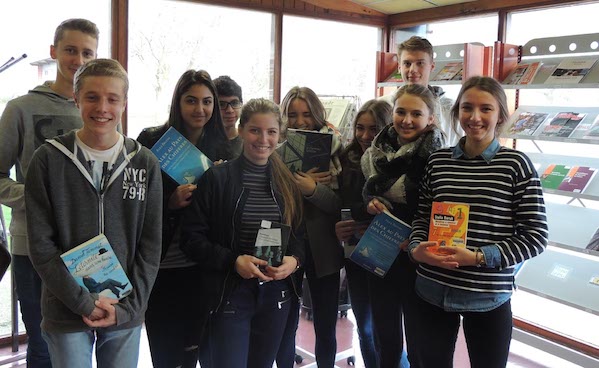
Students from Lycée Jean-Bart in Dunkirk (Nord) who took part in the 2016 Tangente High School Students' Prize.
The inaugural Tangente High School Students' Prize, which has just drawn to a close, saw ten pioneering high schools embark on the adventure by involving their students—more than 150 in all. The overall winner has been chosen: La Pomme d'Alan Turing by Philippe Langenieux-Villard.
The details of how the project was organized locally were left to the team running it, usually a pair of teachers—a school librarian and a mathematics teacher. Some set up a book club; others turned it into an interdisciplinary class project with colleagues from the French department. Some deliberations took place over a meal, as with the Prix Goncourt, and the event was often accompanied by extensive publicity: interviews in the local press, reports by students…
"The students are pleased to see that the results partly reflect their own choices. Overall, they greatly enjoyed most of the titles on offer. Some even featured them in radio segments" writes Isabel, a teacher-librarian at Lycée Pierre-Gilles-De-Gennes in Cosne-sur-Loire (Nièvre).
The hopes behind the creation of the Tangente High School Students' Prize seem to have been fulfilled. The aim was to bring books on mathematics for general readers into CDI school libraries, in the hope of producing two positive effects: encouraging students with an aptitude for mathematics to read, and giving other students a route into the world of mathematics that is closer to their presumed interests.