A code name, a blank sheet of paper, two hours to decode it all
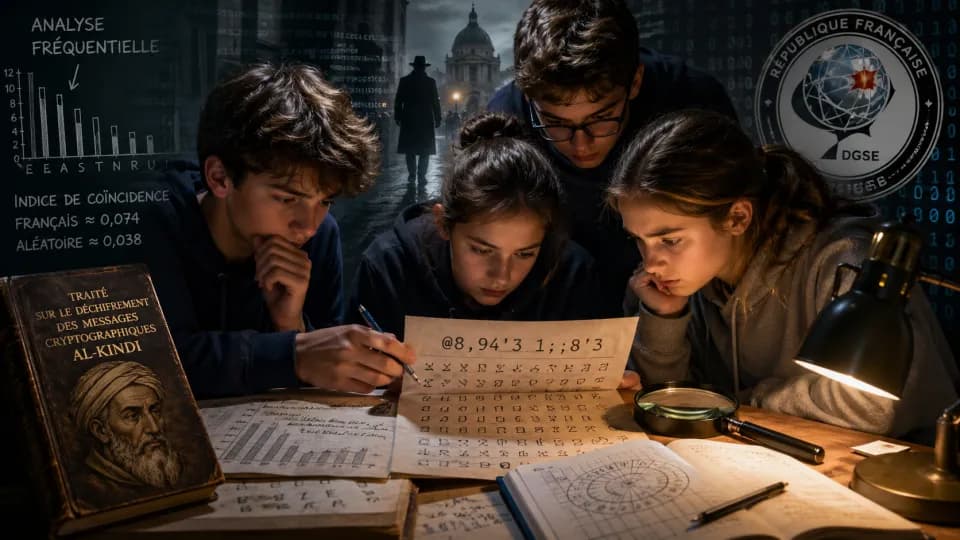
Imagine this: in front of you is a message that looks like this — @8,94'3 1;;8'3. Not a typo, not a glitch. It's the name a team of high schoolers chose to introduce themselves at the national final of a cryptanalysis competition. A mischievous wink: their own name, encrypted. If you can't immediately tell what it means, don't worry — that's exactly the kind of problem these eighth, ninth and tenth graders have learned to solve.
The Alkindi Competition is celebrating its 11th edition this year. Every autumn, tens of thousands of middle and high school students take on cryptanalysis challenges — the art of deciphering secret messages without knowing the key. After three elimination rounds, only 20 teams remain, coming from 14 French académies, Lebanon and Dubai. Their rendezvous: 13 May 2026, at the École des Mines de Paris, for a final two-hour paper exam. Two hours to prove they are the best cryptanalysts of their generation.
But what exactly is cryptanalysis?
Before going any further, let's lay the groundwork. Cryptography is the art of hiding a message — turning it into gibberish that makes no sense to anyone without the key. Cryptanalysis is the reverse: it's the art of recovering the original message without the key. In short, it's the codebreaker's trade.
The competition is named after Al-Kindi, a ninth-century Arab scholar regarded as the father of cryptanalysis. In his Treatise on Deciphering Cryptographic Messages, he describes a technique still used today: frequency analysis. The idea is simple but formidably effective. In any language, some letters appear far more often than others. In French, the e is by far the most frequent letter, followed by a, s, i, t… If someone has encrypted a text by replacing each letter with another — what's known as a substitution cipher — simply counting the frequency of the symbols in the encrypted message is enough to guess which letter each one corresponds to.
This is exactly the kind of reasoning that Alkindi competition participants need to master. And that's where mathematics comes in.
Statistics for spying
Frequency analysis is statistics applied to espionage. But the competition organizers don't stop there. The challenges also call on a somewhat subtler measure: the index of coincidence.
Here's how to think about it: if you take a French text and pick two letters at random, what's the probability that they're identical? In an ordinary text, that probability is fairly high — because some letters recur very often. If, on the other hand, the text has been encrypted in a way that flattens the distribution of letters (as in some more sophisticated ciphers), that probability drops. The index of coincidence measures exactly that: it gives a numerical value to a text's "regularity". For French, it hovers around 0.074. For a random text, it approaches 0.038. This seemingly trivial difference lets cryptanalysts distinguish a simply substituted text from one encrypted by a more complex method — and thus choose the right attack strategy.
"What I love about these competitions is that students discover that math isn't just for filling in boxes in a notebook. It's for reading what others don't want us to read."
From the classroom to the École des Mines
The road to the final is long. Several thousand teams enter each year. Three successive rounds progressively eliminate participants, each challenge stepping up a notch in difficulty. The problems combine logic, probability, modular arithmetic — that way of counting "in a loop", like the hours on a clock — and sometimes even programming.
The 20 teams that survived this marathon come from all over: from Rennes to Réunion, from Bordeaux to Besançon, from Toulouse to Dubai. Their team names are often a first message in themselves — Al Caesarion (a nod to the Caesar cipher, one of the oldest known codes), Les chiffreurs de Metz, Bleizi an Arvor ("the wolves of the coast" in Breton, for the team from the Rennes académie).
On 13 May, these teams won't just spend two hours puzzling over coded messages. The day is designed as an immersion: workshops led by researchers, meetings with cryptography specialists, and a look at the field's real-world applications. Because cryptanalysis isn't just a parlor game — it's at the heart of modern cybersecurity.
When spies back middle schoolers
The Alkindi Competition enjoys institutional support that speaks volumes about its strategic importance. Among its partners: the Ministry of National Education, Inria (France's leading research center in computer science and mathematics) and — rare enough to be worth noting — the DGSE, the Directorate-General for External Security. French intelligence services, then, support a competition for middle schoolers. That's no coincidence: cryptography is one of the pillars of modern intelligence, and training young people in these disciplines means preparing the next generation of cybersecurity experts.
In a world where personal data, diplomatic communications and critical infrastructure all rely on encryption algorithms, knowing how to "break" a code — or at least understanding how it's possible — is a rare and valuable skill. The finalists of the Alkindi 2026 competition have, without necessarily realizing it, acquired a way of thinking that already sets them apart.
Key takeaways
For math enthusiasts
The index of coincidence (denoted IC) of a text of length N containing ni occurrences of each letter i (for i ranging from 1 to 26 in the Latin alphabet) is defined by:
IC = Σ ni(ni − 1) / N(N − 1)
In other words: for each letter, count the number of position pairs where that letter appears twice — that's ni(ni − 1)/2 — and divide the sum of these pairs by the total number of possible position pairs in the text, namely N(N − 1)/2. The result is a probability: the probability that two letters drawn at random from the text are identical.
For an unencrypted French text, IC ≈ 0.074. For a text whose letters were perfectly evenly distributed (26 letters with a probability of 1/26 each), we would get IC = 1/26 ≈ 0.038. A monoalphabetic substitution cipher (each letter replaced by another, always the same one) preserves the frequencies and therefore the index of coincidence. A polyalphabetic cipher (such as the Vigenère cipher, where the substitution changes depending on the position) tends to flatten the frequencies and pushes the IC down toward 0.038. Measuring the IC is therefore the first step in identifying the type of cipher used — even before attempting to break it.