Child's play gone wrong
Imagine a simple rule: take 1, multiply it by 2, add 1, multiply by 2, add 1… Repeat. After ten steps, you get a manageable number. After a hundred, your calculator displays an error. After a thousand, no computer on Earth can store the result. Yet the rule could hardly be more ordinary. What is really going on?
This kind of numerical vertigo is more than a bit of mathematical playground fun. It touches on something profound: the limits of what mathematics can know about itself. And at the heart of this story lies an object as fascinating as it is unsettling—the Busy Beaver function.
When the tortoise overtakes the rocket
To understand why some numbers are "too large" for mathematics, we must first grasp what computable means. A function is said to be computable if a machine—a computer with theoretically unlimited memory and time—can produce its result in a finite number of steps. Addition is computable. So is multiplication. Even functions that grow at a prodigious rate, such as the Ackermann function—which stacks exponentials upon exponentials—remain computable: slow to obtain, certainly, but accessible in principle.
The Busy Beaver function is in a different league. Introduced by mathematician Tibor Radó in 1962, it asks a seemingly innocent question: among all computing machines (called Turing machines) with exactly n internal states, which one halts after writing the greatest number of symbols on its tape? This maximum, denoted BB(n), is the value of the Busy Beaver function at n.
For the uninitiated, a Turing machine is a theoretical model of a computer: it reads and writes symbols on an infinite tape, following precise rules determined by its internal state. It is the abstract model underlying all modern computing. The more states a machine has, the more complex the tasks it can perform.
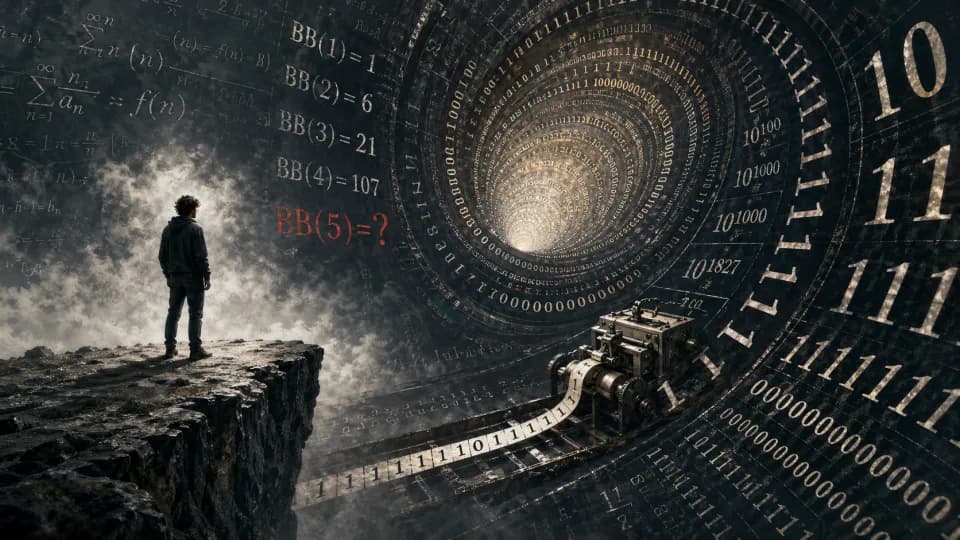
The first values are: BB(1) = 1. BB(2) = 6. BB(3) = 21. BB(4) = 107. And BB(5)? Its exact value is not yet known—the current estimate is around 47 million. BB(6) exceeds 10 to the power of 18,267—that is, a 1 followed by more than eighteen thousand zeros. And BB(7)? No one knows. No one can know.
Arithmetic's speed limit
This is not a matter of insufficient computing power. It is a fundamental limit, akin to the speed of light in physics. The Busy Beaver function grows faster than every computable function. Whatever algorithm you devise, however convoluted, BB(n) eventually overtakes it. This has been proved.
And the consequence is staggering: computing BB(n), even for modest values of n, is impossible in principle. Not "difficult." Not "time-consuming." Impossible. No machine, algorithm or systematic method can produce these values. The Busy Beaver function is what we call non-computable—it exists mathematically, but lies beyond the reach of any mechanical procedure.
"The Busy Beaver function is like a horizon: you know it exists, but you can never reach it."
—
Gödel warned us
To understand why this limit runs so deep, we must go back to the 1930s and the work of Kurt Gödel. In 1931, the Austrian logician proved two theorems that shook the foundations of mathematics. Put simply, the first says that every sufficiently powerful logical system contains true statements that it cannot prove. The second says that such a system cannot prove its own consistency.
These incompleteness theorems mean that there is a boundary between what is true and what can be proved. And the Busy Beaver function lies precisely on that boundary—or rather, beyond it. Determining the value of BB(n) for sufficiently large n amounts to solving problems that standard mathematics—the mathematics we use every day, based on the Zermelo–Fraenkel axioms—simply cannot settle.
Researchers have recently shown that certain BB values are linked to undecidable questions in specific logical systems. For example, BB(748)—a number of unimaginable magnitude—is directly tied to the consistency of Peano arithmetic, the formal system that describes integers. In other words, determining BB(748) would require a logical system more powerful than arithmetic itself.
Layers of logic stacked like Russian dolls
Faced with these limits, mathematicians do not sit idly by. They devise new logical frameworks—stronger axiomatic systems capable of proving more. But each new system encounters its own Gödelian limits. Another, still more powerful system must then be devised. And so on, forever.
It is a dizzying picture: mathematics is not a finished structure, but a tower whose summit can never be seen. Each floor lets us see farther—and reveals how much more remains to be built.
What the Busy Beaver function reveals is that this hierarchy is not abstract. It is encoded in concrete numbers arising from childishly simple arithmetical rules. Addition, multiplication, finite-state machines. Yet these numbers contain all the complexity of the foundations of mathematics.
Key takeaways
For the mathematically minded
The Busy Beaver function BB(n) is defined as the maximum number of "1" symbols written on the tape by any halting n-state Turing machine starting with a blank tape. An n-state Turing machine is a finite automaton with a binary alphabet {0, 1}, an infinite tape, and a transition table: for each pair consisting of a state and the symbol read, it specifies a symbol to write, a direction of movement (left or right), and a new state (or halting).
The non-computability of BB is proved by reduction to the halting problem: if BB were computable, we could decide whether any Turing machine halts—all we would have to do is simulate every n-state machine up to the bound BB(n). But the halting problem is undecidable (Turing, 1936), so BB is not computable either.
More precisely, BB grows faster than every total recursive function: for every computable function f: ℕ → ℕ, there exists an index n₀ such that for every n ≥ n₀, BB(n) > f(n). This property places BB strictly beyond every constructive growth hierarchy (the Grzegorczyk hierarchy, the Ackermann function, etc.).
The connection with Gödel's incompleteness is formal: for any sufficiently expressive, recursively enumerable axiomatic system T, there exists an integer n_T such that T cannot prove the exact value of BB(n) for n ≥ n_T. Recent research has established more precise thresholds for systems such as Peano arithmetic (PA) and ZFC.