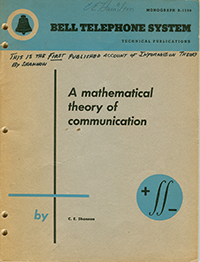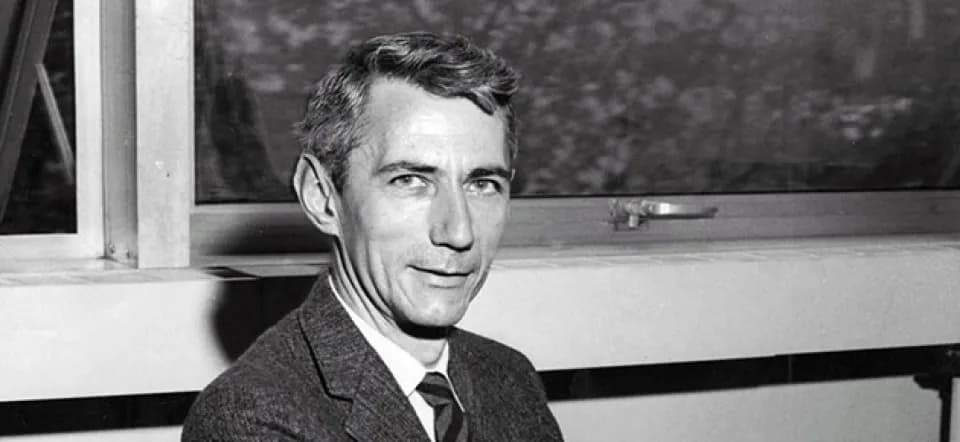
Information theory grew out of a two-part paper Shannon published in 1948, while working as a researcher at Bell Labs. He showed how the previously vague notion of information could be precisely defined and quantified. He established the fundamental unity of all forms and channels of information: texts, telephone calls, radio messages, photographs, films… all can be encoded in the universal language of binary digits, or bits, a term he was the first to use. He put forward the idea that once information had become digital (converted into a sequence of bits), it could be transmitted (or stored) with an arbitrarily low error rate, even if the channel (or storage medium) was itself imperfect and a source of noise and errors. This conceptual leap led directly to fast, robust means of communication and storage.
Too much noise!
---------------
Shannon's information theory showed that the ultimate limits on the capacity to communicate (and store) information were tied to the noise in the channels. In the early 2000s, research into information theory nearly died out: it seemed that these capacity limits had been reached. Recent developments, however, have proved that noise can be quite surprising—and even… useful! The noise considered by Shannon was essentially white, meaning that it had no structure. But the noise encountered in many applications may be more complex and structured, and its correlations may themselves carry a form of information. Research has taken off again, particularly in communications, imaging and seismology.