Leibniz and the dream of mechanizing computation
--------------------------------------------
Gottfried Wilhelm Leibniz is best known in mathematics for his contribution to the development of differential and integral calculus in the 1670s and for introducing notation still used in analysis today. His expertise, however, was by no means confined to mathematics, a field he came to relatively late. It was undoubtedly his enthusiasm for science in general, as well as for philosophy, philology and logic, that led him to devise his calculus ratiocinator. Leibniz argued for the existence of a universal formal language, the characteristica universalis, capable of expressing every conceivable rational discourse. With such a language, it would then have been possible to design a machine capable of solving every theoretical problem expressed in it through a completely mechanized process. Determining whether a proposition was true would thus have been reduced to a simple arithmetic calculation.
As early as 1673, Leibniz also designed a calculating machine that could perform all four arithmetic operations (see Tangente 184), using a system of grooved cylinders to store information!
-
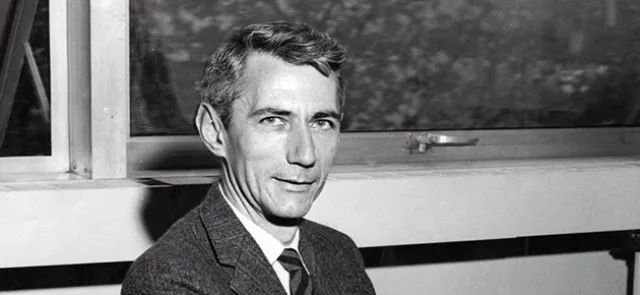
Claude Shannon, a pioneer of information theory
----------------------------------------------------------
The mathematical theory of communication, often shortened to "information theory," was developed by Claude Shannon, a young mathematician from Michigan. Alongside his academic career, he worked as an engineer at Bell Laboratories, renowned in particular for the invention of the transistor in 1948. That same year, Shannon published a pioneering paper in which he began by explaining that the fundamental problem of communication is to reproduce a given message, exactly or approximately, from one point to another. To provide a theoretical framework for all the problems involved, he proposed quantifying the information contained in a message using bits.