A life in the shadows, a legacy in every pocket
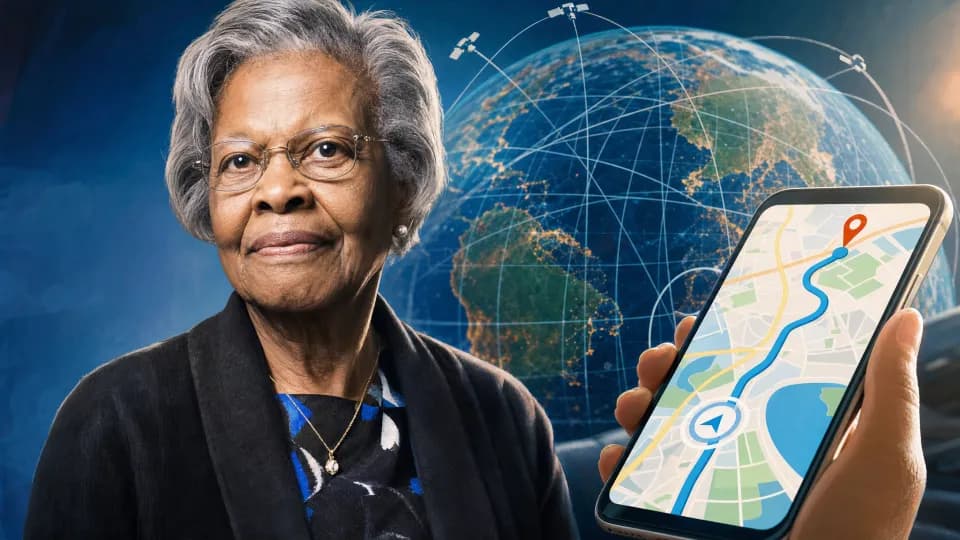
Every day, billions of people turn on their phones, open Google Maps, or ask their car to guide them to their destination. Few think of the mathematician who made it all possible. Gladys West, who died at the age of 95, spent decades solving formidably complex equations at a US military laboratory, never once seeking the spotlight.
Another "hidden figure" — and not the least of them
The name Gladys West inevitably brings to mind the Hidden Figures — the African-American women who, in the 1960s, ran NASA's calculations by hand while their male colleagues reaped the credit. West did not work for NASA, but at the US Naval Weapons Laboratory in Dahlgren, Virginia. Yet the parallel is striking: a brilliant, rigorous Black woman whose work literally changed the world, and whose name remained unknown to the general public for decades.
It is no coincidence that these paths resemble each other. At a time when women and minorities were systematically relegated to computing tasks — regarded as clerical work rather than research — their contributions were often absorbed into larger projects, with no mention of their names. West began working at the naval laboratory in the 1950s, in a context where racial segregation was still a daily reality in the United States.
But what exactly is geodesy?
To understand what Gladys West achieved, we first need to grasp what geodesy is. Imagine you wanted to build a perfect representation of the Earth. The problem: the Earth is not a perfect sphere. It is slightly flattened at the poles, bulging at the equator, and its surface is irregular because of variations in the density of the rock deep below. This is what is known as the geoid — an imaginary shape that the surface of the oceans would take if allowed to spread freely across the entire planet, with no continents and no wind.
Geodesy is precisely the science that seeks to measure and model this complex shape. And that is exactly what Gladys West worked on for years: building a mathematical model of the Earth precise enough for satellites to use as a reference and calculate positions to within a few meters — or even a few centimeters in the most advanced applications.
"The Earth is not round. It is bumpy, flattened, warped. And for GPS to work, every bump has to be known." — One way of summing up the mathematical challenge to which West devoted her career.
Satellites, clocks, and equations
GPS relies on an elegant principle: several satellites continuously send out time-stamped signals. Your phone receives these signals, measures how long they took to arrive, and uses that to work out its distance from each satellite. With enough satellites (at least four), it becomes possible to calculate your position in three dimensions with remarkable accuracy.
But this calculation only works if we know exactly where the satellites are — and therefore if we have a precise model of the Earth they orbit. This is where West's work comes in. By mathematically modeling the Earth's true shape, she provided the geometric foundation on which the entire GPS system rests.
Late but real recognition
For a long time, Gladys West did not appear in science history textbooks. It was only after her retirement, and in particular after the publication of the book Hidden Figures (published in France as Les Figures de l'ombre) in 2016 and the film that followed, that her story began to circulate. Her role in the development of GPS received official recognition. She received academic and military honors. But all of this came very late — well after her work had made its effects felt on the world.
This belated recognition raises an uncomfortable question: how many other Gladys Wests were never recognized? How many major scientific contributions have remained in the shadows because they came from women, from Black people, or from people who simply did not have access to the circles where medals are handed out?
A legacy etched into every journey
There is something deeply poetic in the fact that Gladys West's work is now used by billions of people who do not know her name. Every time a delivery driver finds your address, every time a plane lands in poor visibility, every time a farmer steers a tractor to within a centimeter thanks to precision GPS — a little of her work is quietly at play.
West herself said, in the few interviews she gave after her public recognition, that she had never sought glory. She did her work, with rigor and passion, because it was what she knew how to do best. That may be the purest expression of a scientific calling.
Gladys West's story teaches us that recognition can come late — but it still has value, if only for future generations in search of role models to identify with.
Gladys West did not invent GPS single-handedly. GPS technology is the product of decades of collective work involving engineers, physicists, military personnel, and mathematicians from around the world. But without the precision of her geodetic models, the system would never have achieved the reliability that made it a universal tool. She was, to borrow a geometric metaphor she would no doubt have appreciated, an indispensable reference point — without which everything else loses its meaning.