The first American astronaut to orbit the Earth was John Herschel Glenn Jr. (1921–2016), in 1962. The trajectory calculations for placing his Atlas rocket into orbit had been entrusted to a network of computers. But Glenn asked Katherine Johnson to check every calculation herself, by hand, using pen, paper and a calculator. He declared: "If she says they're good, I'm ready to go!" So who was this Katherine Johnson, whom Glenn trusted far more than the most advanced computer?
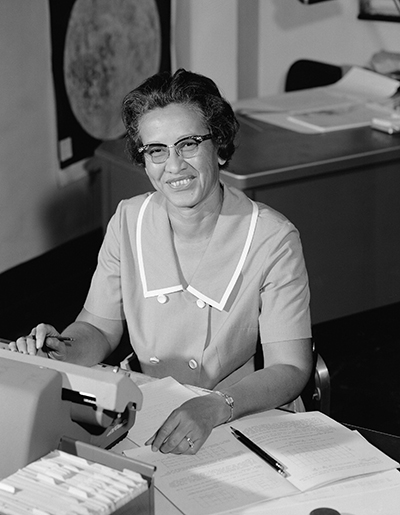
Katherine Coleman Goble Johnson (1918–2020) at Langley Research Center,
in Hampton, Virginia, in 1966.
A "human computer"
------------------
American mathematician Katherine Goble Coleman Johnson was born in 1918 in White Sulphur Springs, West Virginia. Her father was a farmer who also worked at a hotel, her mother was a schoolteacher, and the family had four children. Katherine developed a passion for mathematics and arithmetic at a very early age: "I counted everything I saw—the trees, the number of steps to school; I calculated the height of trees. I couldn't wait to go to high school to study algebra and geometry," she would later write in her autobiography, Reaching for the Moon: The Autobiography of NASA Mathematician Katherine Johnson (Simon-Schuster, 2019). But she was Black, and although West Virginia was not the "worst" of the segregated states, the burden imposed on people of color was crushing: in her county, public education for Black children ended at the age of 12.
The Colemans were determined that their children should receive an education, especially Katherine, whose exceptional gift for science they had recognized. So Katherine, her mother and the other children moved 200 kilometers away to Institute, where Katherine could attend high school, while her father stayed behind to work on the farm; the family joined him there in the summer. Katherine worked at the hotel that employed her father—and learned French there, which she loved. She attended high school, earned her high-school diploma at the age of 14, and then enrolled at one of the few colleges that accepted students of color. That college, also in Institute, admitted such students only to four-year programs. In high school, she encountered the American topologist William Schieffelin Claytor (1908–1967), one of the first Black people to earn a doctorate in mathematics. He encouraged her and arranged for a wide range of courses to be offered so that she could take them. Katherine earned a bachelor's degree in mathematics and French, graduating summa cum laude ("with honors") at the age of 18.
The only career open to an African American woman with a degree was teaching. She became a teacher of mathematics, French and music at a public school and married James Goble (1913–1956). In 1939, a ruling by the United States Supreme Court forced West Virginia University to admit Black students for the first time; she was one of the three students accepted. She stopped studying mathematics in the first year of her master's degree because she was pregnant. The couple went on to have three children. Sadly, James died of a brain tumor in 1956.
In 1952, the National Advisory Committee for Aeronautics (which would later become NASA, the National Aeronautics and Space Administration) was looking for female mathematicians for Langley Research Center in Virginia. Katherine was hired there as a "human computer" (human computer). Among other things, she analyzed gust alleviation for aircraft. She was undoubtedly an exceptionally skilled calculator, but above all she was an outstanding mathematician. Her study of analytic geometry enabled her to unravel problems that her colleagues did not know how to tackle. She also had remarkable intuition and presence of mind.
After the Soviets launched Sputnik 1 in 1957, the Americans were mortified; NASA had to redouble its efforts to salvage the nation's pride. Those in charge eventually recognized Katherine's extraordinary mathematical and computational skill. She worked alongside other Black women, who were treated as women and people of color were treated at the time—that is, very badly. NASA's need to compete with the Soviets and make the best possible use of the talent available to it, combined with Katherine's determination, meant that her situation improved, as did those of the other female employees.
-
A historic trajectory calculation
---------------------------------
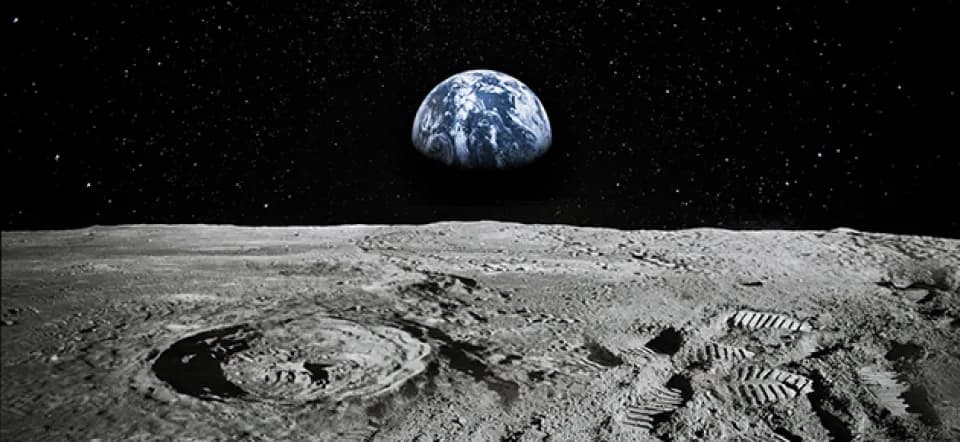
In 1960, Katherine became the first woman to co-author, with engineer Ted Skopinski, a NASA report on the equations describing the trajectory of an orbital spaceflight. The aim was to place a satellite into a preselected orbit. It was this kind of calculation that earned her John Glenn's confidence and enabled her to determine the trajectory of the first men on the Moon when they lifted off again to "head home" in 1969. But she had to fight hard to attend the rocket-launch planning meetings. In fact, she was the first woman to take part in them.
In 1959, she remarried James Johnson and took the surname by which she is known today. They raised her children together and lived in Hampton, near Langley Research Center. Between 1971 and 2019, Katherine received numerous honors. President Barack Obama awarded her the Medal of Freedom in 2015, the highest civilian honor in the United States. She received an honoris causa doctorate from several universities, the Silver Snoopy Award in 2016, which recognizes outstanding contributions to flight safety, and the National Women's History Museum's De Pizan Honor in 2014. Margot Lee Shetterly wrote a book about her (Hidden Figures, William Morrow and Company, 2016), which Theodore Melfi adapted into a film that same year (Les Figures de l'ombre; see Tangente 178, 2017).
Throughout her life, Katherine fought segregation, the exclusion of women, the "coffee pot for people of color" that she was forced to use because she could not share the white employees' pot, and a host of other injustices. But it would be a shame if this made us forget that she was an outstanding mathematician!