The tenth story in Le Livre de sable (Gallimard, 1983)—a mere "anecdote", according to the narrator, who is probably Borges himself—is set in 1970 at the University of Texas in the United States. It features two professors: Ezra Winthrop, originally from Boston, and Éric Einarsson, "the Icelander," who has just secured his first appointment. A third man is mentioned: Herbert Locke, one of Winthrop's colleagues. When the events begin, Winthrop must name his own successor—that is, the lecturer who will take part in the next academic conference on German studies, to be held in Wisconsin. In the university department where he teaches, he knows of only two possible candidates: Einarsson and Locke.
Dilemma, chance and necessity
----------------------------
Winthrop must choose between two professors with contrasting temperaments. He tries to judge them objectively, setting aside his personal preferences. Comparing the two contenders presents him with an obvious moral dilemma: despite his diligence and the considerable help he has given Winthrop over some fifteen years in editing the Geste de Beowulf, Locke is "taciturn and shy", whereas Einarsson is young, brash and fond of controversy. Moreover, his critical edition of Finsburh has recently brought him to the forefront of academic life. He would probably " make a better impression at the conference" than his rival. Yet other considerations, seemingly quite paradoxical, will ultimately tip Winthrop's decision in Einarsson's favor.
Paradox: from the Greek paradoxos, literally "contrary" (para) "to common opinion" (doxa), hence "strange" or "extraordinary." A paradox may take several forms. It may, for example, be:
• a proposition that contains, or appears to contain, a contradiction;
• an argument that, though apparently flawless, leads to an absurdity;
• a situation that runs counter to common intuition.
The narrator tells us that Einarsson is "the true protagonist" of the story. Einarsson decides not to leave his fate to chance: he devises a stratagem that will ensure he is chosen to speak at the conference. During a chance conversation at the Nighthawks on the day he arrives in New York, Einarsson grasps the psychology of Professor Winthrop.
Winthrop is a Northerner. When he moved to Texas, he had difficulty adjusting to "the customs and prejudices of the South." Over lunch that day, the conversation turned to the Civil War. Winthrop told Einarsson that one of his ancestors had fought under Henry Halleck, a general officer in the Union Army. Einarsson had a simplistic view of this chapter of American history, seeing it as a crusade by the Northerners "against the slaveholders" of the South. Yet Winthrop began to argue the Southern cause, maintaining that the South was within its rights in seeking to leave the Union.
He praised the courage of the Confederates. In a flash, Einarsson realized that Winthrop's overriding desire was to appear "impartial." The archetypal Northerner, he had defended the South so that he would be seen as an honorable man. Einarsson drew two conclusions from this first encounter:
• cultural axiom: impartiality is an American passion;
• behavioral axiom: Winthrop is ruled by a passion for impartiality. He therefore always acts so as to maximize his reputation for impartiality.
Armed with these premises, Einarsson devised a paradoxical plan: he decided to write an article attacking Winthrop's teaching methods. In doing so, he presented Winthrop with a simple choice: Locke, his loyal friend, or Einarsson, who had just attacked him. Einarsson based his action on the following result:
Theorem 1: If Einarsson criticizes Winthrop, he will be chosen as Winthrop's successor.
Proof by contradiction: suppose Winthrop chooses Locke as the conference speaker. Since Einarsson has written an article criticizing Winthrop's teaching methods, excluding him would make Winthrop appear to be retaliating against his "attacker" rather than making an objective decision. This would be liable to damage his reputation for impartiality. But that is absurd, since Winthrop acts so as to maximize his reputation for impartiality. Therefore, Winthrop will choose Einarsson.
Winthrop will act exactly as Einarsson predicted: eager to demonstrate his fairness, he will choose Einarsson to represent the university at the conference, despite the Icelander's attack on him.
Revelations and vanity
---------------------
On the eve of his departure for Wisconsin, Einarsson visited Winthrop and revealed what had been going on behind the scenes. Their exchange "went on for some time" and unfolded in three stages.
Act one: Einarsson explained to Professor Winthrop how he had discerned the principle underlying Winthrop's actions—his desire to appear fair-minded on every occasion—and the plan he had devised to ensure his selection as conference speaker.
Act two: Winthrop acknowledged the validity of Einarsson's observations and admitted that he had "yielded to vanity" by refusing to bear a grudge—that is, by choosing Einarsson. He then pointed out the similarity between their behavior: in coming to reveal his stratagem, Einarsson had likewise been guilty of vanity.
Act three: Einarsson took the argument a step further, pointing out that they were united not only by vanity but also by nationality. This claim has surprising implications if we recall the original cultural axiom: impartiality is an American passion. Einarsson does indeed hold an American passport. Yet his behavior has shown that he does not share the American passion for impartiality. Therefore, despite what his passport says, Einarsson is not American.
But then, what defines an "American" if not a passport? One can always reply that a "passport does not alter a man's character," but the problem remains. Einarsson maintains that he is "an American citizen " and that his "destiny lies here," in the United States rather than in "distant Thule." However much he insists that he is not a "Viking," his behavior makes it impossible to regard him as someone driven by a passion for impartiality. Yet he himself described that passion as American…
What are we to conclude from all this? Perhaps this is a logical equivalence—or a definition—that takes no account of geographical or administrative criteria: an American would be someone with a passion for impartiality and, conversely, anyone afflicted by that passion would be American. Thus, an impartial European would be American, while an American citizen who did not share that passion would not be American. Under these conditions, we would no longer have a "cultural" axiom but a tautology: to say that impartiality is an American passion while regarding only those who share that passion as American is indeed circular reasoning.
A pointless action?
-----------------------
Another problem arises: why does Einarsson actually write the article criticizing Winthrop? Does he not see that Winthrop cannot possibly choose Locke, one of his friends, for that very reason?
Theorem 2: Winthrop cannot choose Locke as his successor.
Proof by contradiction: suppose Winthrop chooses Locke as his successor. Since Locke is his friend, Winthrop would be suspected of favoritism, damaging his reputation for impartiality. But that is absurd, since Winthrop always acts so as to maximize his reputation for impartiality. Therefore, Winthrop will not choose Locke.
Thus, whether or not Einarsson writes his article, he will be chosen. It is unlikely that he failed to draw this simple inference himself. Why, then, did he write the article criticizing Winthrop's teaching methods? Part of the answer lies in the fact that, by writing it, Einarsson casts himself as the agent of his own destiny: he will be able to credit his victory to his own actions, like a hero of a Scandinavian epic. His vanity here consists in portraying himself as the architect of the event, when it was in fact inevitable. Even if he had not written his polemical article for the Yale Monthly, the workings of Winthrop's mind would have led him to choose Einarsson. Like Winthrop, Einarsson therefore appears to be his own dupe. The stratagem he invented is actually a labyrinth in which he has trapped himself, perhaps believing that he was condemning Winthrop to it.
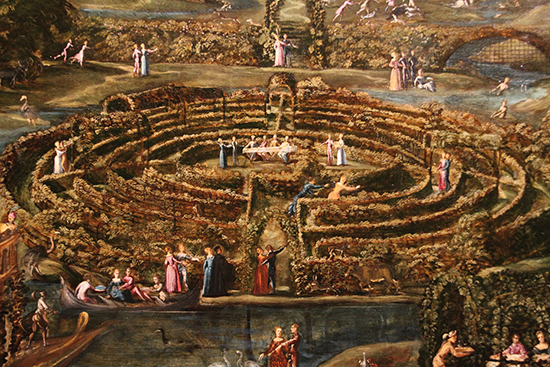
Labyrinthe de l'amour (detail). Tintoretto and workshop, c. 1552.
Turned upside down
-------------------
One element of the author's life remains to be considered. In the opening lines of the story, the narrator tells us that in 1961 he had the opportunity to speak "at length" with Professor Winthrop. Borges's biography tells us that he was indeed appointed as a professor at the University of Texas at Austin in 1961. In a mind-bending reversal brought about by crypto-autobiographical writing, the author himself becomes a fictional element in the story!
This interweaving of real and fictional elements creates a pervasive ambiguity. The reader is left in a state of uncertainty and compelled to seek meaning in the smallest detail. Can it really be mere chance, then, that the date of this encounter—"I96I" in the story—can be read the same forwards and backwards? This symmetry reappears at the end of the story, when the two protagonists emphasize their similarities and both describe themselves as vain Americans.
One of the charms of this short story lies in the way it prompts reflection through an infinite play of mirrors. And two mirrors are all it takes.
*The quotations are taken from the French translation by Françoise Rosset, revised by Jean-Pierre Bernès and published by Gallimard in 2020 under the title Le Stratagème (in Le Livre de sable).*