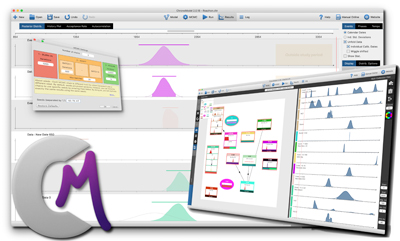
Several suitable software packages are available, including BCal (The BCal Team, 1999), OxCal (Oxford Radiocarbon Accelerator Unit, 1994) and ChronoModel (CNRS, 2015). The last of these grew out of a French collaboration between two teams: one of archaeologists (Institut de recherche sur les archéomatériaux), the other of mathematicians (Laboratoire Jean-Leray).
ChronoModel (**w****ww.chronomodel.com**) can incorporate dates obtained using different methods: carbon-14 dating, archaeomagnetism, thermoluminescence or electron paramagnetic resonance… The prior information essential to Bayesian modelling can easily be added. Prior information means, for example, the period covered by the chronology under study, or stratigraphic relationships between archaeological events or groups of events.
The software is free and "open source" (its source code is openly available). With its user-friendly interface, archaeologists can quickly learn to use it. However, a sound knowledge of mathematical tools, particularly Bayesian statistics, is still required to understand and interpret the results.