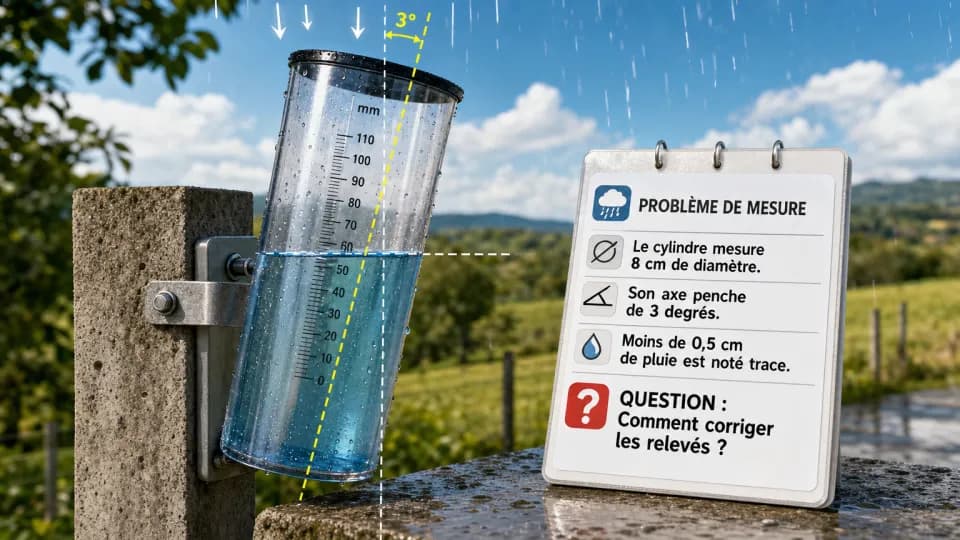
« Oh, mince ! s’exclame le météorologue d’un ton rageur. Je viens de fixer mon nouveau pluviomètre sur un poteau en ciment, et il semble de travers.
– À quoi ressemble ton pluviomètre ? demande son ami, étudiant en mathématiques.
– Il a la forme d’un cylindre circulaire de 8 centimètres de diamètre avec des repères de hauteur tout autour. Son axe n’est que de 3 degrés par rapport à la verticale, mais cela affectera la quantité de pluie entrant par le haut, et d’ailleurs, quel repère de hauteur dois-je utiliser ? Le niveau d’eau semblera incliné. Je suis très découragé par toute cette histoire.
– Ça t’intéresse de mesurer des pluies extrêmement faibles ?
– Pas vraiment. De toute façon, une précipitation inférieure à un demi-centimètre est trop difficile à mesurer avec précision, alors je l’enregistre simplement comme une “trace de précipitation”.
– Je pense pouvoir t’aider » déclare l’étudiant en mathématiques.
Expliquez au météorologue comment corriger les relevés de son pluviomètre posé de travers.