Le quadrilatère | Tangente
♦♦ Le quadrilatère

This article is not yet available in English; the French version is shown.

Articles recommended for you.

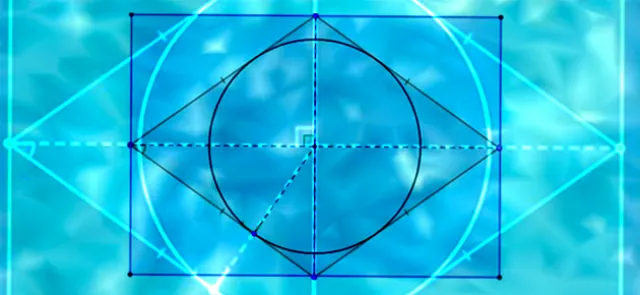
A square is a special kind of rhombus. Anyone can easily calculate the area of a square, but what about the area of a rhombus? Similarly, a square has both a circumcircle and an incircle. What happens in the case of a rhombus?

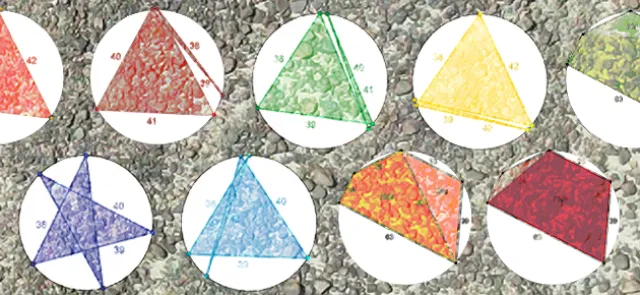
While the geometry of triangles and quadrilaterals has been studied in detail for many centuries, the geometry of pentagons has only recently begun to be explored. Let's follow in the footsteps of Heron, Brahmagupta and Robbins.

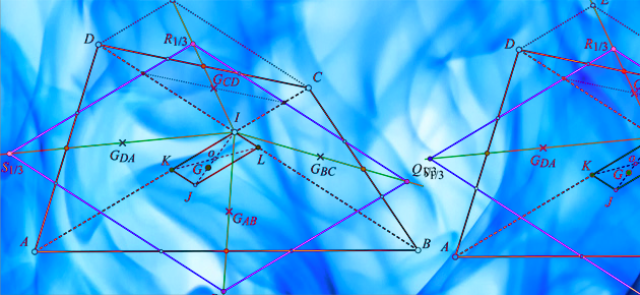
Three sides completely determine a triangle, up to orientation. With four sides, infinitely many polygons can be constructed. Nevertheless, many general properties can be established for arbitrary convex quadrilaterals.

While the formula for the area of an arbitrary triangle has been known for a long time, that of an arbitrary quadrilateral took longer to emerge. Yet the two formulas share a kinship — visual, if nothing else — that is quite fascinating.