Problem 197 in the "Affaire de logique" column of the newspaper Le Monde, titled À la pointe du triangle (At the Tip of the Triangle), is one example. It involves building a numerical triangle of order 5 in which each number is obtained by adding together the two numbers in the row above between which it is placed:
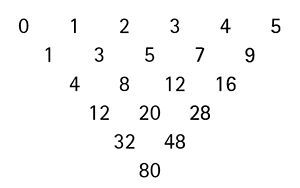
Could you calculate, preferably in your head, the number at the tip of such a triangle, but of order 6? And, without constructing it, give an order of magnitude for the number at the tip of a triangle of order 20?
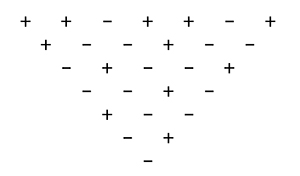
Another example, but without digits this time, is problem 281 from that same column. Here, triangular arrays of "+" and "–" signs are built by writing under each pair of signs the result of a multiplication, following the usual rule of signs: