The prize therefore went not to the teams that discovered gravitational waves, but to three British physicists working in the United States: David Thouless (professor emeritus at the University of Washington), Duncan Haldane (of Princeton University) and Michael Kosterlitz (of Brown University in Providence), "for theoretical discoveries of topological phase transitions and topological phases of matter". With topology, this sounds more like mathematics than physics!
By studying the intermediate phases between different states of matter (then described as exotic), as when ice melts into water, the three researchers identified crucial stages at which certain properties change only in discrete steps, rather like the number of holes in a surface: no holes, one hole, two holes—but never half a hole!
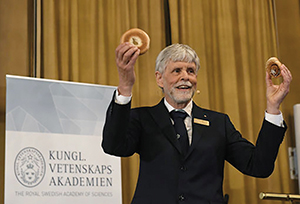
This is what Swedish physicist Thors Hans Hansson tried to explain at the award ceremony using the pastries from his lunch: a pretzel, a donut and a cinnamon roll. The first has two holes, the second just one and the third none. Topology, he explained, seeks invariants—properties of a space that remain unchanged under deformation, provided the object is not broken. The "number of holes" is one such invariant…
Beyond the anecdote's picturesque trappings, this research once again shows the power of mathematics to help explain the world.