Telomeres are key determinants of aging trajectories. Their length, which depends on both genetic and environmental factors, is a valuable biological asset that helps repair age-related damage to cells and tissues. To understand this dynamic, DyLT brings together an interdisciplinary team of mathematicians, biologists, and physicians. The study focuses on three organisms: in humans, statistical analysis of data from large clinical cohorts makes it possible to map the distribution of telomere lengths and their relationship to health; in yeast, DyLT is developing models of replicative senescence and exploring the mechanisms of alternative telomere lengthening, a phenomenon observed in some cancers; and in Pacific corals, using data from the Tara Pacific expedition, researchers are studying telomere dynamics in relation to environmental stress and climate change.
The project draws on a wide range of tools: partial differential equations, stochastic models, and statistical inference from multiscale data, ranging from single cells to entire populations. Beyond modeling, DyLT aims to deliver practical benefits: identifying early markers of aging or disease, gaining a better understanding of cellular responses to disturbances, and predicting the effects of climate on ecosystems.
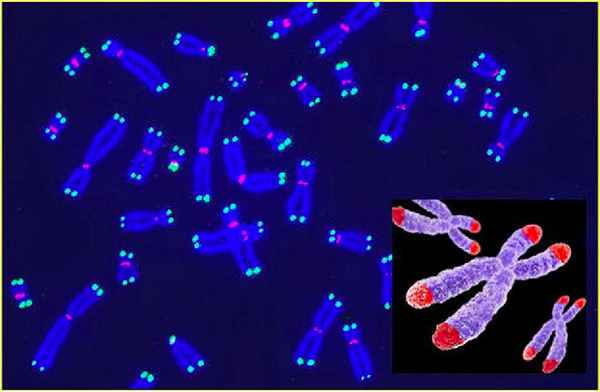
Telomeres (shown in fluorescent blue—and in red in the close-up) are regions
of repetitive DNA located at each end of a chromosome.
They act as protective caps that are essential
for the stability and integrity of genetic material.