The winning book: En cheminant avec Kakeya, voyage au cœur des mathématiques
--------------------------------------------------------------------------------
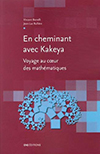
Soichi Kakeya was a Japanese mathematician who posed an open question in 1917: how can a needle lying on a plane be turned all the way around (that is, so that its two ends swap places) while keeping it confined to the smallest possible area?
Starting from this seemingly trivial problem, Vincent Borrelli and Jean-Luc Rullière take the reader on a tour through an impressive range of mathematical fields, exploring them in ways that make them accessible to as many people as possible. This is essentially analysis (differentiation, integration, Stokes' formula, differential equations, envelopes of families of lines…), but also, much more surprisingly, other subjects such as a little-known approach to the density of prime numbers. The review by François Lavallou, published in Tangente 165.
The book, published by ENS Éditions, can be downloaded free of charge as a PDF from the website of the École normale supérieure de Lyon, and can be obtained very cheaply in paperback, for example from the Infinimath bookshop http://www.librairie-archimede.com/
-
Ten years of joint work to write a book
----------------------------------------------

Vincent Borrelli is a senior lecturer at the Institut Camille Jordan (Université Claude Bernard-Lyon 1). His research field is differential geometry. He was the co-founder, and later the director, of the MMI (Maison des mathématiques et de l'informatique). He was also a member of the editorial board of the CNRS outreach website Images des mathématiques. Jean-Luc Rullière, after spending some twenty years in the Lyon area as a student and then as a high-school mathematics teacher (it was there that he became friends with Vincent Borrelli), left to work in Spain under the Agence d'enseignement français à l'étranger (AEFE), at the French high school in Bilbao, then in Germany, at the French high school in Berlin, where he currently teaches.
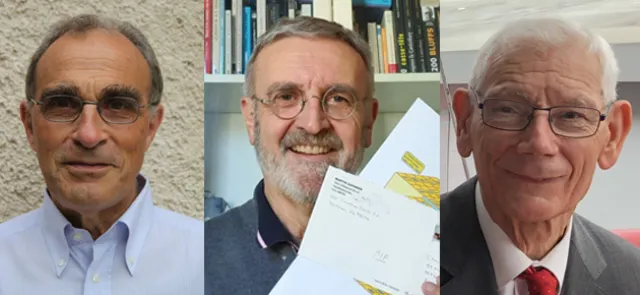
Interviewed at the Trophées Tangente award ceremony, the two authors described how they wrote this book together, how a very different initial project led to the result we know today, and they dwelt on both the pleasure and the difficulty of writing as a pair. You don't always agree on the angle to take, you try to persuade the other, you make concessions, you stop everything at a moment of tension, you start again…
In short, achieving the quality of the finished product took nearly ten years!
No one will regret their persistence.
-
Numbers and hands-on work: getting people to love mathematics
----------------------------------------------------------
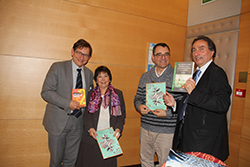
Two books received a special mention in the 2015 Tangente Book Prize.
Nombres à compter et à raconter (Le Seuil), by Stella Baruk, is a dialogue between the author and a middle-school student in which, through exchanges about the numbers from 0 to 10, the reader discovers the fascinating topics these conversations allow them to explore (see the review by Élisabeth Busser, published in Tangente 161)
Les constructions mathématiques avec des instruments et des gestes (Ellipses), meanwhile, is a collective work, written by the interIREM commission "history and epistemology" and coordinated by Évelyne Barbin. Geometric constructions using instruments are presented in it as methods used throughout history to "measure the inaccessible," especially when calculations do not make it possible to find exact solutions (see the review by Élisabeth Busser, published in Tangente 164).
The reviews of these three books, along with many others, can be found in the reading section of the website www.infinimath.com (under the "books" heading).