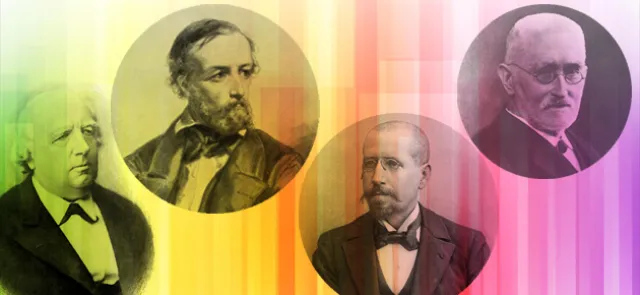
Until the 19th century, the real numbers seemed simply to be given by nature. It therefore made no sense to consider their structure, a fortiori to construct them. Yet since the 17th century, mathematicians had known how to establish a correspondence between the points on a line and the real numbers, given an origin and a unit. In the 19th century, everything changed. Mathematicians became aware of the distinction between physical reality and its mathematical modelling. The logical consequence was that mathematics had to be built on rigorous foundations. This process of maturation lasted almost the entire century, driven by the pressing need to define the real numbers, starting from the rational numbers, which seemed to have a tangible reality. In particular, this was essential if basic theorems about continuous functions, such as the intermediate value theorem, were to be proved without appealing to geometric intuition. This was the work of several mathematicians, including Karl Weierstrass, Charles Méray, Richard Dedekind and Georg Cantor.
-
Order, completeness and intervals
--------------------------------
These mathematicians "constructed" the set of real numbers from the set of rational numbers, commonly called fractions. The key argument is what is known as completeness. Just as π, obtained through successive approximations, came to be accepted as a number, we want to add to the rational numbers all the potential limits of sequences that turn out not to be rational. Let A be a nonempty subset of the real numbers. An element m of A is called an upper bound of A if, for every element x of A, we have x ≤ m. The completeness of the set of real numbers means that every nonempty subset of A that is bounded above (that is, has at least one upper bound) has an infimum: in other words, there exists an upper bound M of A (necessarily unique) such that M ≤ m for every upper bound m of A.