Numbers lie at the heart of mathematics. Natural numbers were introduced to solve counting problems; other kinds of numbers were subsequently studied to solve an ever wider and deeper range of problems. Yet the apparently combinatorial, arithmetic concept of number has an interesting geometric interpretation through the number line.
-
Extensions of the natural numbers
------------------------------------
Natural numbers (1, 2, 3…) allow us to count objects while disregarding their particular properties. As mathematician Leopold Kronecker (1823–1891) famously put it, "God made the integers; all else is the work of man". Adding or multiplying two natural numbers always produces another natural number. But the two fundamental operations of addition and multiplication can be reversed only under severe restrictions: for example, the subtraction 1 – 2 is not defined, and division without a remainder is not possible, if we restrict ourselves to natural numbers. Introducing zero and negative integers on the one hand, and fractions on the other, freed subtraction and division from these constraints, with the proviso that division by 0 remains meaningless. Rational numbers thus comprise integers and fractions, whether positive, zero or negative. Each can be written in the form a0.a1a2a3…, where a0 denotes a signed integer, while a1, a2, a3… are decimal digits, so the decimal point separates the integer part from the fractional part. The decimal representation of any rational number either terminates or is non-terminating but repeating. Rational numbers obey the familiar rules of algebra: they form a totally ordered commutative field.
Unfortunately, there are not enough rational numbers to meet every mathematician's needs. Irrational numbers were therefore introduced; their decimal representations are non-terminating and non-periodic. The real numbers comprise all rational and irrational numbers. Each therefore has a decimal representation, either terminating or non-terminating, and in the latter case either periodic or non-periodic. Widely used in classical analysis, real numbers are as numerous as the points on a line and are manipulated algebraically in the same way as rational numbers. They too form a totally ordered field, one that contains the field of rational numbers but is, this time, complete in a precise sense.
-
Hyperreal and other nonstandard numbers
----------------------------------
There is no strictly positive real number smaller than every other strictly positive real number (if such a real number a existed, we would have the contradiction a < a / 2). To fill this gap and solve problems arising in analysis, Gottfried Wilhelm Leibniz (1646–1716) and his successors used non-real numbers described as positive infinitesimals: they are indeed strictly positive, but smaller than every strictly positive real number. Taking their opposites gives negative infinitesimals, while taking their reciprocals gives infinite numbers—that is, numbers greater than any real number. They can also be added to any real number x, producing numbers infinitely close to x. The existence of all these new numbers was justified in the 20th century by Canadian mathematician Abraham Robinson (see Tangente 149). In the 1960s, Robinson constructed them explicitly using rigorous but fairly sophisticated reasoning based on the mathematical concept of an ultrafilter.
Together with all the real numbers, positive and negative infinitesimals, positive and negative infinite numbers, and numbers infinitely close to a real number make up the hyperreal numbers. They obey the same algebraic rules as the real numbers: they too form a totally ordered commutative field, containing the field of real numbers. They provide the basis for what is known as nonstandard analysis. One of Robinson's students, Albert Harold Lightstone (1926–1976), established that the number 0.999…, whose integer part is zero and which is written with an infinite number of decimal digits, all equal to 9, is such that the difference 1 – 0.999… is a positive infinitesimal. This result confirms the intuitive belief, common among many beginners in analysis, that 0.999… is "a little smaller" than 1.
-
Say it with lines
--------------------------
Let X and X' be two points determining a line. The line can be traversed in two opposite directions. We choose one of them, from X' toward X, and call it the positive direction; the other is naturally called negative. The positive direction is indicated by an arrow drawn on the line itself, which then becomes an oriented line. We next choose a unit of length u for measuring line segments on the axis. Any segment \[AB\] is assigned a + or – sign according to whether it is traversed from A to B in the positive or negative direction of the axis. This gives the segment a signed length, .

In this example, and
We arbitrarily choose a point O on the line (X'X); this will be the origin of the axis, and is assigned the value 0. The number 1 is assigned to the endpoint of the segment starting at the origin and having signed length 1, while –1 is assigned to its reflection across O. We then assign the number 2 to the endpoint of the segment starting at O and having signed length 2, and, of course, –2 to its reflection across O. Continuing in this way, every positive and negative integer is represented by one of a series of equally spaced points on the oriented line, with the positive integers on one side of the origin and the negative integers on the other. These points may be called integer points and identified with the integers.

Similarly, fractions whose denominator is the natural number n can be given a geometric interpretation. Simply divide each unit-length segment between two consecutive integer points into n equal parts: together with the integer points, the subdivision points form what may be called rational points. Each of these is then uniquely characterized by a rational number.
A rational number a is less than another rational number b if and only if the point representing a lies "to the left" of the point associated with b. The natural ordering of the numbers therefore coincides perfectly with that of the corresponding points on the oriented line! Furthermore, the rational points are dense on the line (X'X). In other words, every segment of the axis that is not reduced to a single point contains rational points, however short it may be.
-
Holes everywhere
------------------
Although every rational number corresponds to exactly one rational point on the axis, the converse is not true! In other words, the rational points do not "fill" the line. The geometers of ancient Greece showed that there are points P on the axis for which the length of the segment \[OP\] is incommensurable with the unit of length u, meaning that these two quantities have no "common measure." Numerically, this means that the signed length is not a rational number. This is the case, for example, when P is the endpoint of the diagonal \[OP\] of a square with side length equal to the unit u and which is positioned as in the figure.
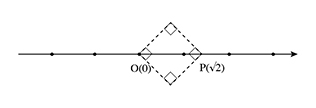
By Pythagoras's theorem, OP2 = 2. We can therefore associate the number √2 with the point P; it is the positive solution of the equation x2 = 2. This number is not rational.
More generally, by associating a unique number, called an irrational number, with every non-rational point on the line (X'X), every point on the axis is characterized by exactly one rational or irrational number. This number is called the point's coordinate. Thus, every point on the axis is characterized by a unique real coordinate, either rational or irrational. In all, there are exactly as many real numbers as points on the line. Moreover, numbers and points can, in a sense, be "identified." The axis (X'X) is naturally called the real number line.
But the real numbers are contained within the hyperreal numbers. It is therefore only natural to try to represent the latter geometrically using the real number line!

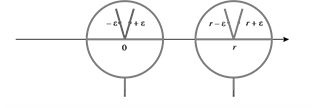
To begin with, non-real hyperreals cannot be located directly on the axis (X'X), since the points on this line correspond exactly to the real numbers. Some hyperreals can nevertheless be pictured virtually by aiming an "infinitely powerful magnifying glass" at the origin of the usual number line. This thought experiment reveals numbers invisible to the naked eye—and hence non-real—but infinitesimal because they are infinitely close to 0. They form the halo of 0. In the following figure, the halo of 0 is represented symbolically by two kinds of antenna above the origin O of the real line, containing the infinitesimals below and above 0. The same figure also shows what happens when the magnifying glass is moved and centered on any real number r: non-real numbers infinitely close to r then appear, such as the numbers r +
and r – , which form the halo of r.
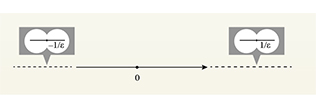
Furthermore, there are positive and negative infinite hyperreals. They cannot be seen with the naked eye on the real number line, but we can picture them using "infinitely powerful binoculars aimed as far as possible" to the right or left. In this way, we can form a mental picture of positive and negative infinite numbers respectively, such as 1 / and –1 / , where is an infinitesimal.
**
**
Taken together, infinitely powerful magnifying glasses and binoculars allow us to form a mental picture of the hyperreal numbers associated with the points of what might be called a hyperreal number line. It consists of the points on the real number line, each accompanied by a halo of infinitely close points, together with "infinitely distant" points lying to the right or left.