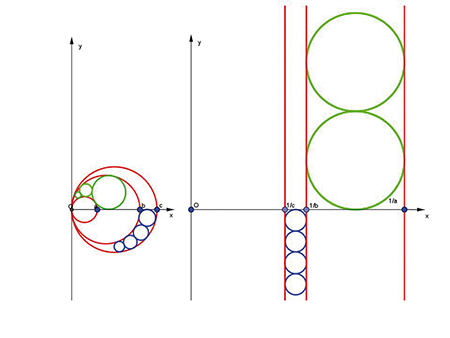
The operations on the complex numbers z (with image M) and z' (with image M') all have a geometric interpretation: addition z + z' corresponds to the vector sum subtraction z – z' to the vector , and multiplication zz' to the image P such that OP is the product of the moduli of z and z' and the angle is the sum of their arguments. But what about division? For instance, taking the inverse? In this transformation, which maps z to z' = 1/z, the argument of z' is the negative of that of z, and the modulus of z' is the inverse of that of z, provided z is nonzero. This lovely transformation, in which the point O has no image, turns every circle through the origin into a line that does not pass through O, every circle not passing through O into a circle that does not pass through O, and conversely, all while preserving tangencies, so that the figure on the right is the image of the figure on the left (and vice versa).