=========================
Shock waves through the academic community
-------------------------------------
Defying the predictions of most opinion polls, Republican candidate Donald Trump will take office on January 20. Tangente does not normally comment on politics. Yet our magazine has always championed reason over fanaticism. We may therefore legitimately be concerned by the triumph of a candidate who has systematically pilloried those whose education and judgment qualify them to make sound decisions. The election has shaken the US academic community so deeply that the American Physical Society's director of public affairs has declared: "Trump will be the first anti-science president in our history." Let's hope he is wrong.
-
An archaic system: elected with fewer votes!
-----------------------------------------------
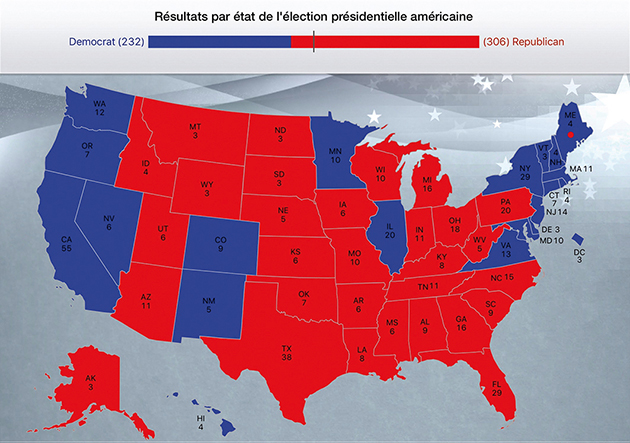
The system for electing the US president has remained unchanged since the late 18th century, retaining an anachronism that no longer makes sense today. Each state appoints a number of electors based on its population, with 538 in all. Each state has as many electors as it has members of Congress: two senators, regardless of its population, plus a number of representatives allocated by the highest averages method. This distinctly favors less populous states, most of which support the Republicans.
When a candidate wins a majority in a state, all that state's electors are pledged to that candidate. On election night, therefore, the nationwide total of votes cast for each candidate matters little: one simply adds up the electors from the states where each candidate finished first. The system can thus elect a candidate who received fewer votes nationwide than their opponent, as happened in 2000—and again today.
-
Another polling error?
--------------------------------
Because opinion polls have a mathematical basis, the error seen in this election deserves scrutiny. Donald Trump's unconventional and "disreputable" image probably led some respondents to lie about how they intended to vote; France witnessed the same phenomenon with Jean-Marie Le Pen. For months, every polling organization had predicted a Hillary Clinton victory—except one: the Los Angeles Times, whose method asked respondents to assign a probability to voting for each candidate. This probably accounted better for last-minute changes of mind. Even so, the newspaper's forecast also differed markedly from the actual result, but in the opposite direction.
How were the polls wrong? Nationwide, in terms of votes, Hillary Clinton was forecast to lead her opponent by 3.2 percentage points; she received only 0.5 percentage points more. The result did fall outside the theoretical confidence interval, though only narrowly. Based on the very latest state-by-state polls, Clinton would secure 272 electors and Trump 266, with 270 needed to win—a gap that had narrowed considerably in the final days.
In 47 states, the forecast proved correct. What misled observers was the error in the remaining three: Wisconsin, Michigan and Pennsylvania, which together account for 46 electors. In Wisconsin, the error was enormous: Trump won by one point, although the polls had Clinton leading by 6.5 points. In the other two states, it remained small—around two points—but was enough to tip the result. Despite receiving fewer votes, Trump ultimately won with 306 electors to Clinton's 232.
This kind of voting system magnifies the risk of forecasting errors, particularly when voting intentions are nearly evenly split in several states.