Watching a wind turbine turn, one would never guess that the air around it is both orderly and chaotic. First, it is orderly because the turbine’s rotating blades create a wake—the change in flow caused by the presence of an obstacle. This wake slows the air and generates vortices. These form at the blade root and tip, where the low pressure on one side of the blade meets the high pressure on the other.
Maths in the wind
-----------------
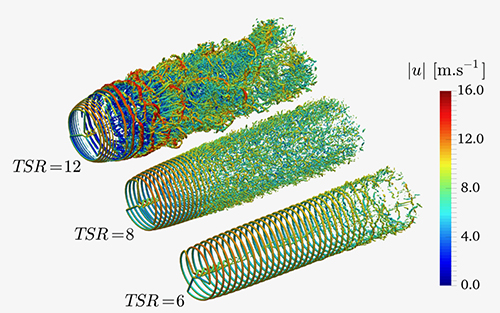
The resulting vortices spiral downstream of the rotor because of the rotation of the blades. When the rotational speed is low, they remain stable for a long time and travel over very long distances. As the speed increases, the vortices begin to interact and pair up, eventually becoming unstable and mixing. The higher the speed, the sooner and more violently this instability develops. At high speed, the “tangle of rainbow spaghetti” shown in the top image actually represents air vortices of different sizes, shapes and speeds. This is why the air is also described as chaotic. The Reynolds number is used to measure the “amount of chaos” (see FOCUS). For atmospheric flow around wind turbines, the Reynolds number can exceed ten million! At such a value, the flow is therefore highly turbulent.