Since the mid-1980s, Total has increased its computing power 10,000-fold, culminating in the launch of Pangea III in June 2019. With a performance of 25 petaflops—25 quadrillion operations per second, equivalent to one hundred and thirty thousand laptops—and a storage capacity of 50 petabytes, it ranks No. 11 among the world's most powerful supercomputers, whether publicly or privately owned (June 2019 TOP500), and No. 7 among the most energy-efficient (June 2019 GREEN500). This computing power comes from combining five hundred and fifty-eight compute nodes, each equipped with two eighteen-core IBM Power9 CPUs (running at 3.45 GHz) and six NVIDIA Volta GV100 GPUs.
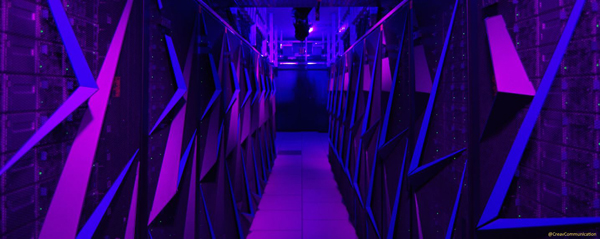
Pangea III, Total's new supercomputer.
Two types of modeling
--------------------------
Historically, Total's compute-intensive work has focused on modeling complex physical phenomena. Examples include depth imaging and reservoir simulation, which account for 95% of Pangea III's use.