It is often said that a picture is worth a thousand words. Among younger people, digital images have indeed become the most widely used means of non-verbal communication.
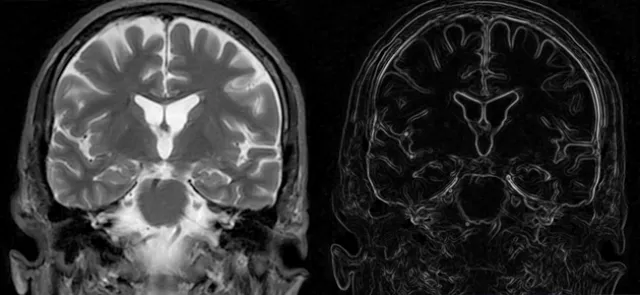
Image processing is the scientific discipline concerned with "manipulating" digital images or extracting information from their content. Familiar examples include compression, which prevents images from taking up too much space on our computers or hard drives; denoising, which aims to remove imperfections from images captured in low light; color management, which produces more satisfactory color rendering; and medical imaging, which helps doctors detect and treat diseases.
The proliferation of digital images on the Internet and on smartphones explains the growing interest in processing them. For about fifteen years now, this has been a major area of research in applied mathematics and computer science.
Denoising
-------------
The earliest denoising models relied on a very simple principle: replace the color of each pixel at position x in the image with the average color of the pixels in a neighborhood centered at x. This neighborhood must be "small enough" to ensure that the colors being averaged are visually "similar" to the color of the central pixel. Probability theory guarantees that if the average is taken over nine pixels, the standard deviation of the averaged noise is divided by three, thereby denoising the image (see the feature "The Central Limit Theorem" in Tangente 168, 2016).