



Bees, they can count!
Bees are now at the center of public debate regarding the importance of their survival for natural balance. They are also fascinating for their unexpected mathematical abilities: they can count up to five and even perform simple operations! This suggests the idea of universality of the simplest mathematical reflexes and allows, in turn, for a better understanding of human phenomena such as learning in children or dyscalculia problems. However, their supposed geometric genius, which we think we perceive through the hexagonal shape of the cells, would not be their doing but attributable to physical laws. Let us go and harvest the mathematical honey of bees!
All articles in this folder
 Podcast
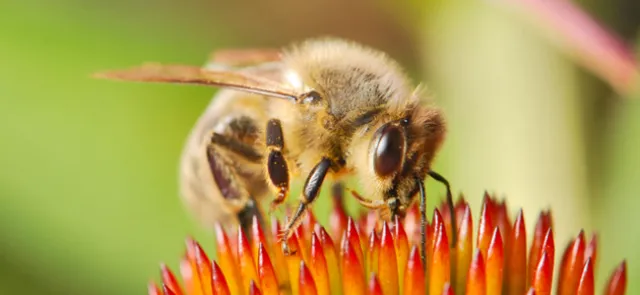
Bees and the abstract sense of number | Tangente
Research into bees' cognitive abilities shows that they can count up to five, order numbers along a mental number line that includes zero, perform simple operations, and even associate a number with a symbol. This suggests the near-universal nature of mathematics.
 Podcast
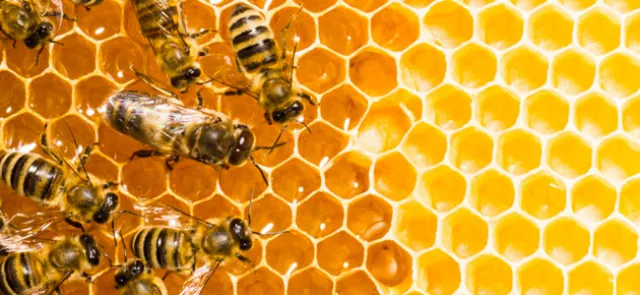
The geometry of honeycomb cells
Bees do not shape their honeycomb cells into hexagons deliberately, but because of the viscoelasticity of wax: the cells, initially circular, compress against one another, the wax melts and angles begin to form; the circular shape becomes hexagonal.
 Podcast
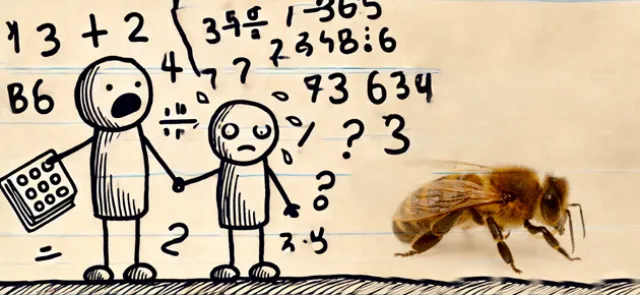
From bees to dyscalculia | Tangente
Catherine Thevenot studies the link between number and space, notably through bees' innate abilities. Her work sheds light on how mathematical skills develop in children, whether or not they are affected by dyscalculia.