Catherine Thevenot is a professor at the Institute of Psychology at the University of Lausanne, where she co-directs the Laboratory for Brain and Cognitive Development. Specializing in learning and the development of numerical skills in children, she studies bees to identify the innate biological mechanisms behind this learning.
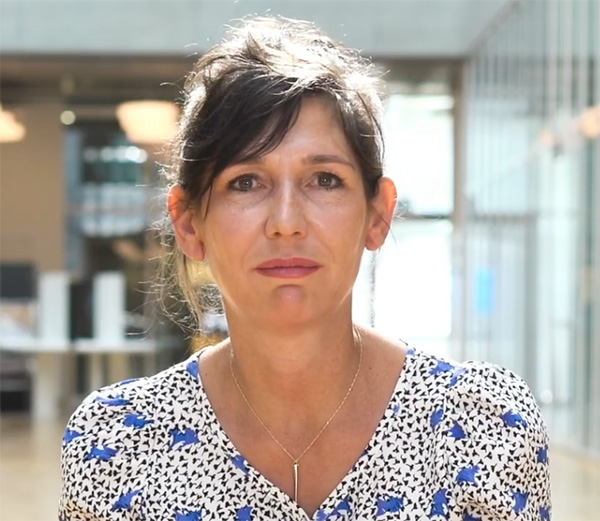
Catherine Thevenot.
Tangente: What are your current research projects?
Catherine Thevenot: I'm currently working a lot on finger counting. We have spectacular results on the value of teaching such a method to five-year-old children. I'm also working on the relationship between number and space, as well as on how adults solve multiplications. I have about thirty projects underway, many of which revolve around these themes.
What role do bees play in your research?
I worked on bees with my colleagues Martin Giurfa and Rosa Rugani as part of my research on the relationship between number and space. Martin is one of the world's leading bee specialists, with a more biological approach than mine, and Rosa had already demonstrated chicks' ability to organize quantities from left to right.

Domestic honeybee, Apis Mellifera.
So you're interested in how bees organize and perceive numbers in space. How do you go about this?
A study conducted on bees showed that they spontaneously organize quantities along a left-right spatial axis. After being trained to recognize a target quantity (three items, say), the bees are confronted, during testing, with two identical sets that do not correspond to the learned quantity (for example, one item on the left and one on the right, or five on the left and five on the right). Significantly, they head more often toward the set on the left when it contains a quantity lower than the target, and toward the one on the right when it contains a higher quantity. This behavior suggests the existence of a spatial representation of quantities, in which small values are associated with the left and large ones with the right.
What is at stake in this research?
The fact that humans who write from left to right also mentally organize numbers from left to right has been known for decades. But a major question is whether this mental organization is purely cultural. In cultures where people write from right to left, numbers tend instead to be mentally organized from right to left as well, which is an argument for saying that culture is responsible for the mental organization of numbers. Yet in babies or chicks, who have not been steeped in the culture of reading, a preference has been shown for organizing small quantities on the left and larger ones on the right. We then wanted to find out whether this result was also observable in insects, and it is! We can therefore conclude that the left-right organization of quantities rests on biological foundations, but that our innate representations are modulated by culture. This research matters because determining the most natural organization for children to represent numbers will make it possible to design suitable learning programs. Our research confirms, for example, that the classic use of number lines oriented from left to right in classrooms is a good idea. Of course, in early learning, the ordinal aspect of number — the fact that 3 comes after 2, say — has to be linked to its cardinal dimension, the fact that 3 contains 2.

Carpenter bee (Xylocopa) foraging on a broom flower.
What techniques do you use to explore the human brain?
To study learning in children and adults, I use methods that observe behavior and record brain activation. In bees, for now, we have limited ourselves to observing their behavior. By contrast, brain activations have been identified that change over the course of development and learning, in 8-year-olds, 13-year-olds and adults, when solving arithmetic problems.
Speaking of which, how would you define automated counting procedures?
When you solve a very simple addition such as 2 + 3, you don't feel like you're counting — the answer simply pops into your mind. Researchers long thought that this rapid solving was possible because, after many repetitions, the fact 2 + 3 was stored in long-term memory. It would then have the same status as knowing that Paris is the capital of France. Yet in my studies, we show that what experts do to solve this type of problem is not retrieving a fact from memory. They actually implement an extremely fast, unconscious counting procedure. This procedure amounts to taking small steps of 1 along a mental line oriented from left to right, which is where the connection with my work on bees comes in.
Here, the "experts" are the individuals who have automated these procedures, generally at the age of 13. Establishing exactly what experts do when they solve calculations is crucial for developing suitable learning methods for young children. So the conclusion of my work is that it is not a good idea to have children learn addition tables by heart, as is sometimes done in certain schools. What should be favored instead is counting, on the fingers for example.
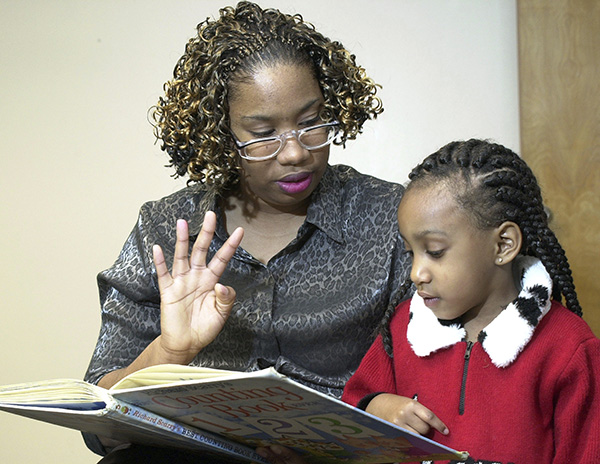
The widespread use of calculators and technological tools has profoundly transformed our daily lives. Is finger counting still a necessary step in the development of numerical skills?
What we show is that very few children can do mental arithmetic easily without first going through a stage of finger counting. So, while not necessary for the proper development of arithmetic skills, finger counting is indeed an important step. Children should be given a calculator as late as possible in their schooling, because it is extremely important for children to be able to manipulate numbers, count and calculate, so that they can eventually automate their calculation procedures. A child who knows that 7 × 6 = 42 will always be faster than one who has to reach for a calculator. The time and cognitive resources saved on carrying out the calculation can then be used for more interesting, higher-level activities, such as grasping the mathematical statement in which the calculation is embedded, or understanding the geometric principle behind calculating an area. In other words, children who cannot automatically solve simple calculations will have less chance of developing advanced mathematical skills, of reasoning effectively when faced with complex problems, and of approaching abstract concepts with confidence.
Could you walk us through how an observation session with children unfolds?
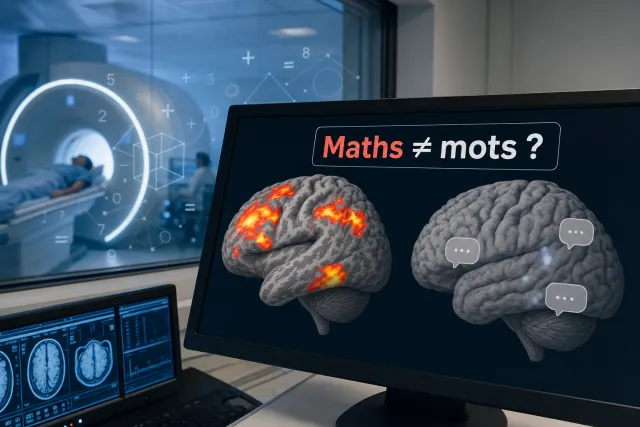
The great majority of the observations we carry out on children take place in their schools, and we include all children who fall within the age ranges we are interested in. Sometimes, after the fact, we exclude from our analyses allophone children\ who would not have understood our instructions, or, depending on the aims of our research, children who might present learning disorders. (\ An allophone person is someone whose native language differs from the language used in the experiment). Sometimes it is precisely these children who interest us, particularly if they present dyscalculia. We may ask children to solve small, simple calculations, that is, with single-digit numbers, and we film them in order to code their behavior afterward. Many of my studies also use reaction times, in which case the numerical tasks are presented on a computer. As for the brain-imaging studies, which I carry out in collaboration with my colleague Jérôme Prado, based at the neuroscience research center in Lyon, the procedures are more complicated. The children have to come to the research laboratory with their families. Before the actual experiment in the scanner, the child is familiarized with the equipment, so as to get used to the environment, the noise made by the MRI (magnetic resonance imaging) machine, and the requirement to remain still during the study. Scanners designed to look like rockets, for example, are often used to reassure children and give the situation a playful feel.
Where do things stand regarding dyscalculia?
Dyscalculia is a developmental disorder affecting the acquisition of knowledge related to number and arithmetic. It affects 3 to 6% of children, and its origins are partly genetic.
Several hypotheses may explain the disorders it causes. For some researchers, it constitutes a primary disorder stemming from a difficulty in grasping numbers in their non-symbolic format, or from a difficulty in matching the non-symbolic format to the symbolic one (for example, I I I corresponds to the symbol "3"). For other researchers, it corresponds instead to a secondary disorder linked, for example, to deficits in working memory capacity, visuospatial skills and inhibition, or else — and this is what will be discussed here — to procedural automatization. Moreover, these hypotheses are not necessarily mutually exclusive.
The procedural automatization deficit hypothesis accounts for one of the greatest obstacles that dyscalculic children face in developing their numerical skills, namely their difficulty in solving arithmetic problems easily. We have recently shown that these difficulties are even more pronounced for addition than for multiplication. So the difficulties of dyscalculic children would lie more at a procedural level than at a memory level. Indeed, while the results of multiplications are learned by heart and thus ultimately stored in long-term memory, the same is not true of additions, which are practiced in the early grades through counting.
Children indeed begin to solve additions by working through the number chain in steps of 1, very often with the help of their fingers. The addition 2 + 3, for example, is classically solved by representing 2 on one hand, 3 on the other, and recounting all the raised fingers starting from 1 (that is, 1, 2; 1, 2, 3, and so 1, 2, 3, 4, 5). As development proceeds, these counting strategies become simpler, starting from the larger of the two operands (in our example, one starts from 3 and counts: 4, 5). According to the automated counting theory, these procedures never disappear entirely, and even the adult expert solves small additions through counting procedures, which have become so fast that they are no longer accessible to consciousness. This automatization of procedures, which would thus correspond to the hallmark of expert functioning in solving arithmetic problems, appears to emerge around the age of 12–13 in children without learning disorders.
So the major problem for dyscalculic children, or at least for some dyscalculic children, could lie in their failure to automatize counting procedures. This hypothesis accounts for their slowness in carrying out operations and the cognitive cost, which remains high in comparison to non-dyscalculic children, who solve the same operations very quickly, with practically no effort.
Do observations of bees play a role in the study of dyscalculia?
This work, carried out on a non-human, non-verbal species, suggests that certain foundations of numerical cognition, such as the spatial organization of quantities or unconscious calculation procedures, might rest on basic biological mechanisms shared across species. In the context of dyscalculia, this makes it possible to better pin down the fundamental components of number sense, independently of language or formal teaching. By identifying the spatial-organization biases that underlie the representation of quantities, this research could help design suitable pedagogical tools aimed at reinforcing these early spatial representations in children experiencing difficulties. For example, playful interventions drawing on the left-right axis, or the manipulation of concrete numerical spaces, could help support the development of number sense and offset certain weaknesses observed in dyscalculic children.
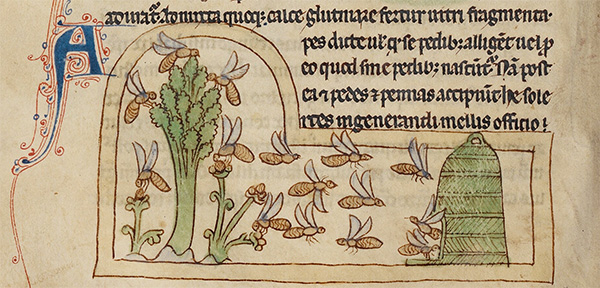
Bees depicted in the Northumberland Bestiary, written around 1250–1260, Getty Museum.
What advances have been made in understanding the role of memory in learning?
There is no learning without attention and memory. These two cognitive pillars underlie all learning. If we cannot direct our attention to a piece of information, it will never pass into memory. If we suffer from a memory disorder, information we have attended to will quickly and permanently vanish from our mental world. Interactions between memory and attention are thus at the heart of all research on learning. Recent research shows, however, that jellyfish, which have no central nervous system and therefore no brain, can learn through associations. The possibility of this kind of learning, though very basic, is surprising to researchers, who will need to understand how it is possible without attentional and memory capacities governed by the brain.

Domestic honeybee, Apis Mellifera, foraging on a bellflower.
At what age does reasoning first emerge in human beings?
From birth, children have impressive intuitions about their environment. They are surprised, for example, that a chair might move on its own, that 1 + 1 could equal 1 (through magic tricks, say), or that a solid object might pass through another. At this age, however, we cannot yet speak of reasoning. It is only from around 5 to 6 years old that children begin to be able to reason about concrete situations, that is, ones involving objects or images. Several more years will still have to pass, though, before they can reason about hypotheses or abstract concepts.
Interview conducted by Mireille Schumacher