



Paradoxes to think about
A situation is generally described as "paradoxical" without really knowing what the notion of paradox means. If this word is vague, it is because the concept of paradox can take on many meanings, particularly in mathematics: a result that seems absurd, a result that seems to go against a theory, or even a situation where one no longer knows what to conclude. The common point of all these meanings is the astonishment one feels, an astonishment that is beneficial for the mind because it forces one to ask questions: have I been fooled by my intuition? This will be the case with Simpson's and Penney's paradoxes. Will I be able to find a convincing answer? We will see this with the two envelopes paradox. Does the conceptual framework of the problem have a blind spot? This will be the adventure of Allais's paradox. We will end with the aperitif...
All articles in this folder

The notion of paradox in mathematics | Tangente
The terms "paradox" and "paradoxical" are part of everyday language. In mathematics and logic, however, they have precise meanings that need to be clarified if we are to understand what we are talking about and what status to assign to so-called "paradoxical" results.
Simpson's paradox and appearances | Tangente
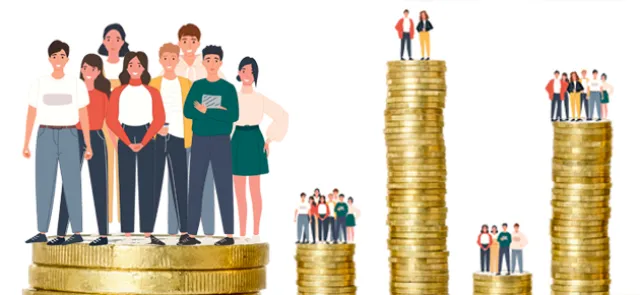
Could something that is true in every subgroup of a population become false when the population is considered as a whole? How is that possible? This is exactly what Simpson's paradox—the best-known paradox in statistics—shows.

The two-envelope paradox | Tangente
A paradox can sometimes resemble an urban legend. First, its precise origins may be difficult to pin down; second, over time it may become distorted, change form, and proliferate. Such is the case with the two-envelope paradox.

Allais and the limits of utilitarianism | Tangente
The paradox formulated by the French economist Maurice Allais exposes a contradiction in an earlier theory of decision-making. But the paradox is only apparent and, above all, illustrates a major limitation of rational choice theory.

The surprising aperitif problem | Tangente
Where should a platter of canapés be placed to satisfy the guests as well as possible? This seemingly innocuous problem has inspired brilliant developments over the centuries. It also illustrates how individual and collective optimization are often at odds—a seemingly paradoxical result.
Penney's paradox explained | Tangente
Does tossing a coin strike you as simplistic and dull? Be careful, though: it has some baffling surprises in store!