A simple case—with a catch
-------------------------------
If you toss a fair coin twice in succession, the possible outcomes are TT, TH, HT and HH, each of which is equally likely. If you toss the coin a great many times, the frequencies of these four outcomes will be very similar. Consider TH and HH in particular: which is more likely to occur first? The question seems harmless, yet if you try your luck over a few tosses, you will be surprised to see TH win far more often! This paradox was first proposed in a recreational mathematics journal in 1969 by Walter Penney (1913–2000), a cryptanalyst who worked for the US defense establishment and was a great enthusiast of puzzles of every kind.
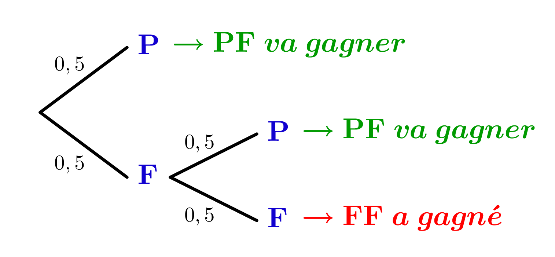
How can this phenomenon be explained? The subtlety lies in the phrase "occur first". If the first toss is T, TH is certain to appear before HH, as soon as the first H occurs. If the first toss is H, however, there is a one-in-two chance that the next toss will be T, returning us to the first situation, in which TH will win, and a one-in-two chance that it will be the second H. All told, the probability that TH appears before HH is 75%!
####