In Les voies du paradoxe (The Ways of Paradox), the logician Willard Van Orman Quine (1908–2000) distinguishes between two types of "paradox" using two examples. The first is illustrated by the fictional example of Frederic, the hero of Arthur Sullivan's operetta The Pirates of Penzance, who has reached the age of 21 despite having celebrated only five birthdays. How can this discrepancy between his age and number of birthdays be explained? The paradox here arises because we generally equate the number of years someone has lived with the number of years in which they have celebrated a birthday—an assumption that breaks down for anyone born on February 29.
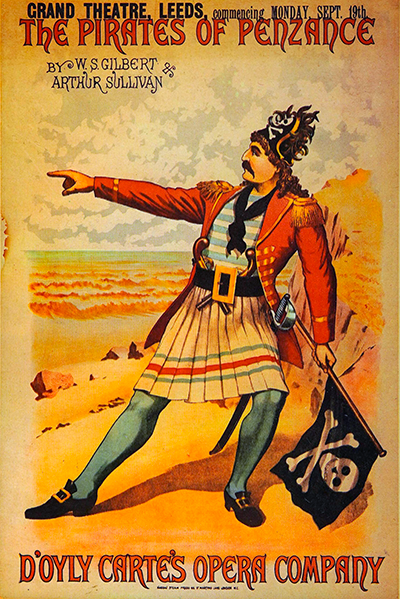
Poster for The Pirates of Penzance, Grand Theatre, Leeds, 1881.
The second example, which the logician Bertrand Russell took from a source unknown to us, concerns a barber who shaves all the men in the village who do not shave themselves, and only those men. If the barber does not shave himself, then by hypothesis he must shave himself; but if he does shave himself, then by hypothesis we can say that he does not shave himself. This leads to a contradiction, making the very definition of such a barber inadmissible and the problem meaningless.
Falsidical or veridical?
-------------------------