



To begin
All articles in this folder
Pascal's 400th anniversary in Clermont | Tangente
In Auvergne, the city of Clermont-Ferrand, Clermont Auvergne Métropole and the University of Clermont Auvergne (UCA), together with their many partners, are preparing to celebrate the 400th anniversary of Blaise Pascal's birth in 2023.
Fondation Blaise-Pascal—Maths for all | Tangente
The Fondation Blaise-Pascal was launched in 2016 by the CNRS, Université de Lyon and Inria. Its aim is to support mathematics and computer science outreach organizations, enabling them to develop and sustain their activities over the long term.
Blaise Pascal prize — Researcher award | Tangente
The Blaise Pascal Prize recognizes work carried out in France on the application of mathematics to engineering and industry.
A prize for mathematics theses | Tangente
The prize awarded by Clermont Auvergne University's Blaise-Pascal Laboratory honors a thesis in pure or applied mathematics.
Centre international Blaise-Pascal (CIBP) | Tangente
Among its missions, the Centre international Blaise-Pascal is compiling a comprehensive bibliography of research on Blaise Pascal.
Pascal in space: a lunar crater | Tangente
Astronomy has paid tribute to Pascal twice.
Pascal on a 500-franc banknote | Tangente
Known as the "Pascal", this 500-franc note bearing the scholar's portrait had a long career: it remained legal tender from 1969 to 1997.
Pascal, hero of Italian cinema — Rossellini's film | Tangente
The film is little known to general audiences today, but Blaise Pascal is the title character of a feature film directed in 1971 by Roberto Rossellini, a leading figure of Italian neorealism.
Pascal on stage — Descartes and Pascal on stage | Tangente
The mathematician is also one of the central characters in a philosophical comedy by Jean-Claude Brisville (1922–2014), best known to the general public for Le Souper (1989), featuring Talleyrand and Fouché, whose film adaptation was a memorable success.
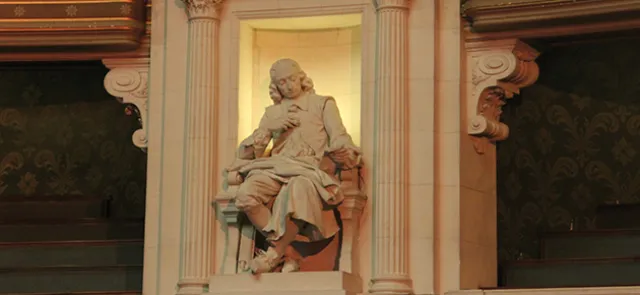
An extraordinary mind — The life of Pascal | Tangente
Blaise Pascal was no universal scholar, but he developed a rigorous, experiment-based scientific method that enabled him to transcend the prevailing orthodoxy and open up new avenues in both mathematics and physics.