Since 2009, the Tangente Awards have been organized by an association, the Club Tangente. Alongside Éditions POLE, several partners support the awards. This year's partners were the APMEP, the SMF and the CultureMath website.
Three awards were presented in 2021: the Tangente Book Prize and its younger sibling, the Tangente High School Students' Prize, as well as the Best Article Prize.
Let's begin with the best-known and longest-established of the three, the Tangente Book Prize.
Tangente Book Prize: a hotly anticipated award
---------------------------------------------------------
Keenly anticipated by readers of popular science and publishers alike, the Tangente Book Prize is awarded each year to a book "that makes readers want to learn more about mathematics."
Books published between January 1st of the previous year and June 30 of the current year that have been reviewed in Tangente are put to an online vote, with readers selecting the five books that the jury then faces the difficult task of deciding between.
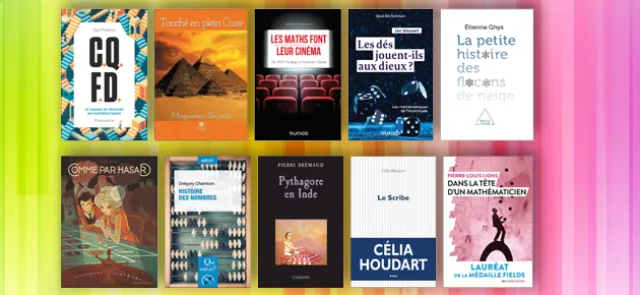
Here is the list of the 2021 "nominees," together with the issue of Tangente in which each review appeared (available at tangente-mag.com):
• CQFD. Yan Pradeau, Flammarion, 2020 (see TG197);
• Touché en plein Caire. Moquaden Shomiti, Le lys bleu, 2021 (see TG198);
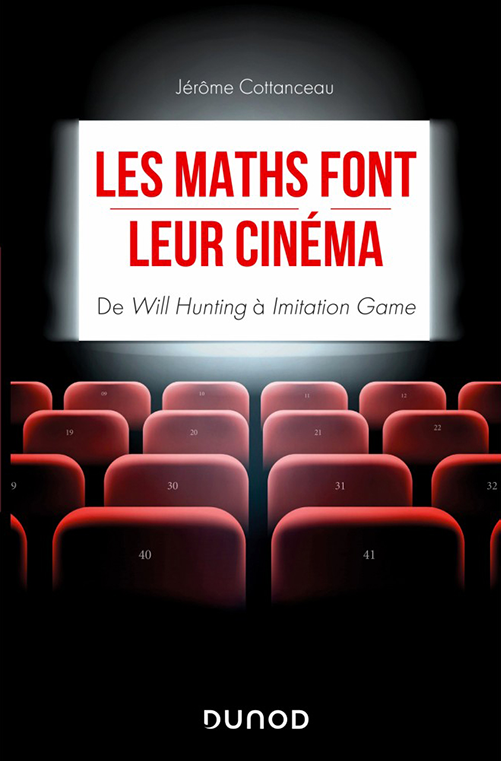
• Les maths font leur cinéma. Jérôme Cottanceau, Dunod, 2021 (see TG198);
• La petite histoire des flocons de neiges. Étienne Ghys, Odile Jacob, 2021 (see TG199);
• Pythagore en Inde. Pierre Brémaud, Cassini, 2020 (see TG199).
The 2021 Tangente Prize was awarded to Jérôme Cottanceau for his book Les Maths font leur cinéma, de Will Hunting à Imitation Game, published by Éditions Dunod.
This book presents fourteen landmark films released between 1997 and 2017, selected for their treatment of mathematics. For each film, after a brief synopsis, the author examines its connections with mathematics, taking the opportunity to explain and explore in greater depth the concept touched on onscreen. He also discusses the technical aspects of filmmaking and the work of the scientific advisers—generally leading researchers—who helped with the writing or filming. His analysis goes so far as to dissect the notes written on blackboards in the background of classroom scenes. The jury, comprising figures from the world of mathematics, a library representative and the previous year's winner (Manu Houdart), appreciated the book's broad appeal and its use of cinema to popularize mathematics. Rather than becoming a catalogue, the book offers an in-depth look at each film, making readers want to watch or rewatch it in this new mathematical light. The jury eagerly awaits the second volume and hopes it will be in color. It certainly deserves it!
The Tangente Book Prize also awarded two commendations. The accompanying certificates were created by artist Sellig Zed.
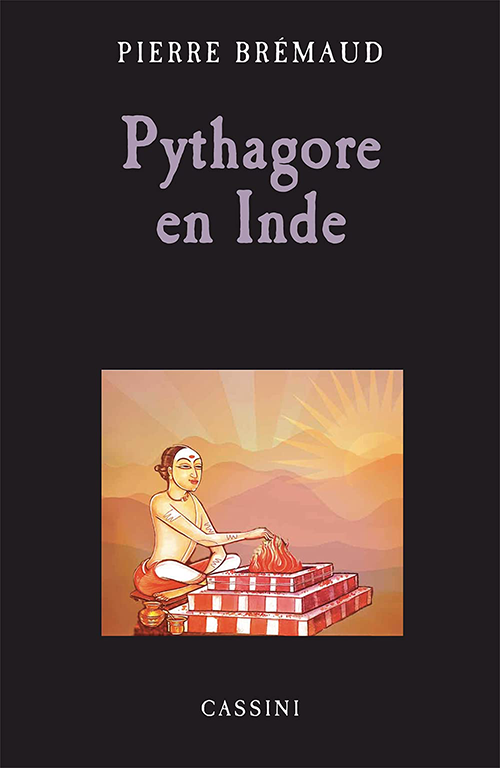
*Pythagore en Inde* (Cassini) was written by Pierre Brémaud, professor emeritus at the École polytechnique fédérale de Lausanne and author of textbooks and research works—particularly on probability and stochastic processes—as well as the Dossier Pythagore, published in 2010 by Ellipses. His book is an essay on the history of mathematics that draws on formidable scholarship to trace the origins of the famous theorem concerning the hypotenuse. The jury appreciated the accessibility of this thoroughly researched book, which opens up interesting perspectives and casts the Pythagoreans in a new light. The author succeeds in his aim of making sophisticated writing on the history of mathematics accessible to everyone. The book is a pleasure to read, both for its style and for its wealth of ideas.
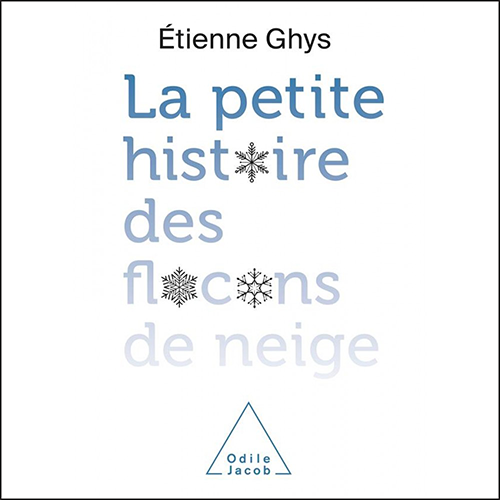
The other commendation, *La Petite Histoire des flocons de neige*, is a short text accompanied by beautiful, evocative illustrations. In this poetic book published by Éditions Odile Jacob, Étienne Ghys, a renowned mathematician and permanent secretary of the Académie des sciences since 2018, takes readers by the hand and shows them that this universal subject can be explored scientifically. The jury greatly appreciated his particularly lucid treatment of crystallography.
Tangente High School Students' Prize: a growing success
-------------------------------------------------
More successful with each passing year, the Tangente High School Students' Prize (PTL) has become an essential part of the marriage of mathematics and literature.
More and more schools and students take part each year. The 2022 edition is currently under way in more than forty high schools, involving nearly 600 students. Each school chooses how to organize its participation: book clubs, interdisciplinary projects, review writing, literary lunches, meetings with writers…
Here is a reminder of how it works: over the course of the school year, students read a selection of ten books about mathematics and vote for their favorite. The results are then sent to the Club Tangente organizing team, which compiles them and announces the winner.
Each year's selection includes a range of types of books—novels, essays, graphic novels, biographies and more—on subjects related to mathematics (see the sidebar for the 2021 selection, whose awards were presented on December 16). The aim is to introduce students to another side of mathematics.
####
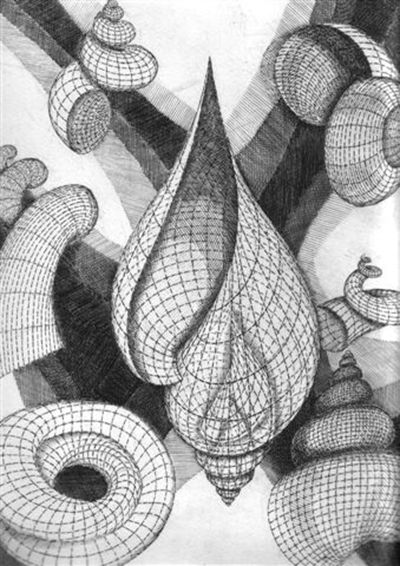
The engraving by Patrice Jeener.
The 2021 Tangente High School Students' Prize, for which students read the shortlisted books during the 2020–2021 school year, was awarded to *Combien de pas jusqu’à la Lune*, a book by Carole Trébor published by Éditions Albin Michel.
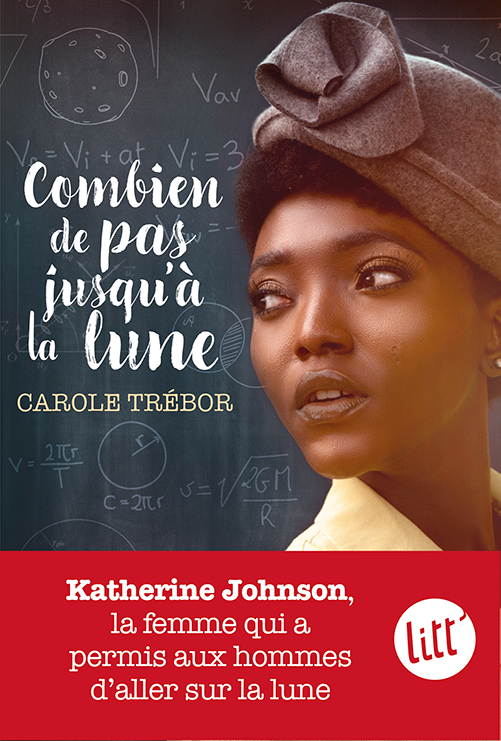
This biographical novel, written in 2019, recounts the life of mathematician and space engineer Katherine Johnson, who became widely known through the film Les Figures de l’ombre (Theodore Melfi, 2016) and died in 2020 at the age of 102. Full of admiration for the book's heroine and her journey, the students greatly enjoyed following a true story that also echoes contemporary issues, including women's careers, the place of minorities and discrimination.

A trained historian, Carole Trébor is a writer specializing in children's and young adult literature. She has also produced programs and series, particularly for Arte and France 5. She has just published the first volume of a historical series, "Jeanne, la fille du docteur Loiseau" (Albin Michel Jeunesse). The mathematical artwork presented to her is Patrice Jeener's engraving Coquillages, also known as Nature et mathématiques.
Young people are also very interested in gaining a better understanding of artificial intelligence and its consequences, as shown by the two books that received commendations in the Tangente High School Students' Prize.
The first, *Ada *is a novel by Antoine Bello, a writer who has been well known since his first book appeared in 1996. Based in the United States and the great-grandnephew of Marcel Aymé, he has this time devised a story revolving around an artificial intelligence tasked with writing romance novels that has… disappeared from a research laboratory. The book raises questions about the relationship between AI and creativity.
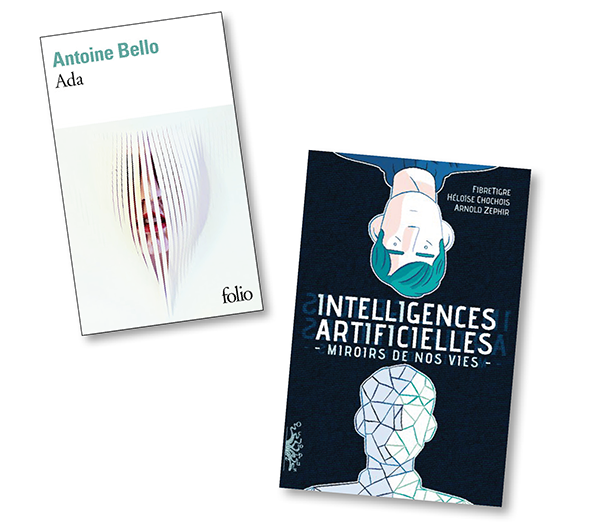
The second commendation went to *Intelligences artificielles,* a graphic novel published by Delcourt that had already received a commendation in the 2020 Tangente Prize. It features the AI Yuri and its creators, exploring the social and ethical questions raised by the use of AI in our lives. Its authors are Héloïse Chochois, Arnold Zéphir and FibreTigre, who entered the Tangente Best Article Prize a few years ago.
Best article: Isabelle Santos
----------------------------------
Now for the Best Article Award, presented to a non-professional author. It recognizes a topic related to mathematics, or its role in another field, presented via a recent, unpublished article in an engaging form accessible to a broad audience. Club Tangente presents this award in partnership with CultureMath, the APMEP and the SMF.
Since the award was created, its winners have received a photographic artwork with a mathematical theme by Denise Demaret-Pranville, with a different work chosen each year. Shown opposite is the 2021 trophy, entitled Escalier eschérien à Rodez.
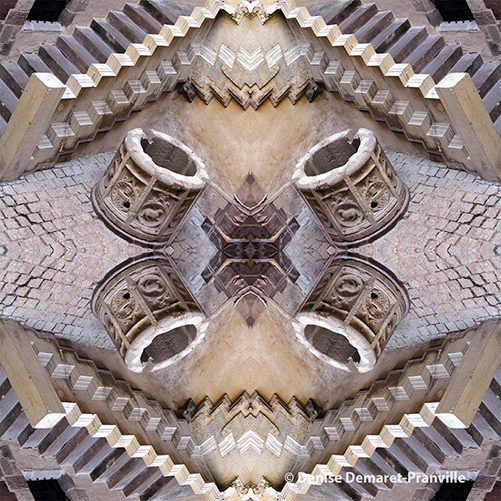
More importantly, the winners also have the privilege of seeing their article published not only in a forthcoming issue or special edition of Tangente, but also through the partners' communication channels.
By entering, you may discover a new calling: several previous winners are now regular contributors to Tangente. Fabien Aoustin, now well known to our readers, began his writing career in our pages... by competing for the Best Article Award! We also occasionally publish articles by Christian Laforest or Antoine Rolland; they too have won the Best Article Award run by Club Tangente.
The 2021 winner is Isabelle Santos, from Toulouse, an applied-mathematics researcher working in astrophysics.
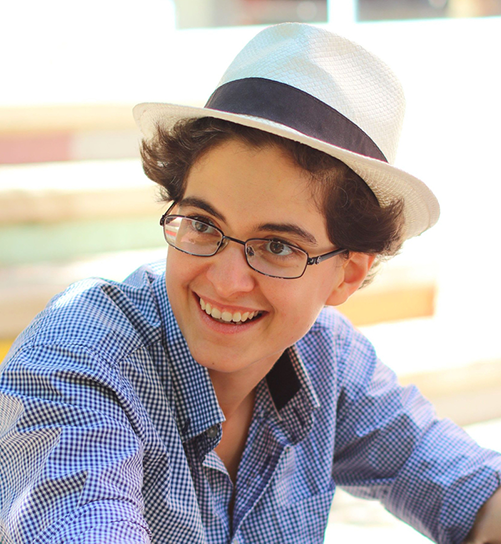
Her text, taken from her blog ("Le blog du moutmout", **https://blog.isabelle-santos.space*) is entitled Mesurer les distances dans le système solaire*. In it, she clearly explains how scholars in antiquity devised ingenious methods based on simple properties of geometry and trigonometry to calculate the radius of the Earth, as well as the distances from the Earth to the Moon and the Sun. The article concludes in the 17th and 18th centuries, when the heliocentric system was universally accepted and planetary distances were being calculated. The article's accessible style will enable a broad readership to understand the fascinating field of the motion of bodies in the solar system.
A new Tangente Award: the Logic Matters Award
--------------------------------------------------------
As some of our readers have noticed, the Bernard Novelli Award has been put on hold. Too few middle and high school students entered in 2020, forcing Club Tangente to suspend it.
But another challenge was launched in 2021: a problem-writing competition. It proved so successful that, from 2022 onward, it will be held as part of the Tangente Awards under the name "Logic Matters Award." The rules and call for entries will be published in March 2022, but you can already start dreaming up the original problem that will make you one of the winners!
The wonderful adventure of the Tangente Awards continues.