The new year often provides an opportunity for all kinds of numerical fun. Here, for example, are a few equations sent in by Gérard Crézé from Saint-Michel-en-l’Herm:
(1 + 2) × 3 + 4 × 56 × (−7 + 8) × 9 = 2025;
(1 × 2 + 34) × 56 + (−7 + 8) × 9 = 2025;
− (1 + 2 × 3) + (34 − 5) × 67 + 89 = 2025.
The game has been popular since 2011, when filmmaker Takeshi Kitano, as part of a contemporary art exhibition, proposed finding an expression for that year’s number using the consecutive integers in order and separated by the usual mathematical operators (+, −, ×, /, square root, factorial and exponents).
For 2025, one example is: − (1 + 2) + (3!)4 + 5 + 6! + 7 = 2025.
You will certainly find many more! Can you manage with fewer than the first seven integers?
Strong ties to 45
-----------------------
Many of the distinctive features of 2025 are worth noting. Several are linked to its square root, 45, whose base-2 representation is palindromic (101101). Like every square of an odd number, 2025 is a centered octagonal number. In other words, it can be represented by points forming concentric regular octagons with side lengths 0, 1, 2, 3, and so on.

25 is a centered octagonal number.
The three octagons consist of 1, 8 and 16 points.
To see why the centered octagonal numbers are exactly the odd squares, consider the proof without words—yet no less eloquent—shown below for two particular cases.

Transforming centered octagonal numbers into square numbers.
Thus, 2025 can be represented by 23 concentric octagons, the largest consisting of 176 points.
The surprising connections between 2025 and its square root do not end there! You are probably familiar with twin primes, pairs of prime numbers only two units apart, such as 5 and 7, 11 and 13, or 29 and 31. Between 2025 and twice that number, there are exactly 45 primes p for which p + 2 is also prime.
Here is another diversion: try partitioning 45 into at least three distinct integers. For example, 45 = 2 + 3 + 10 + 30 and 45 = 14 + 15 + 16 are such decompositions, whereas 45 = 20 + 25 and 45 = 10 + 10 + 25 are not. You should find quite a few: there are exactly 2025.
Sums to keep you up all night!
-------------------------------
Speaking of figurate numbers, you have probably already heard of triangular numbers. These are obtained by summing consecutive integers from 1 onward: *Tn = 1 + 2 + 3 + … + n = n (n* + 1)/2.
Since 2025 is a square, it is the sum of two consecutive triangular numbers: 2025 = T44 + T45.
More generally, a simple algebraic calculation shows that
n2 = *Tn*–1 + *Tn*.
But 2025 is also the square of a triangular number, since
45 = T9 = 1 + 2 + 3 + 4 + 5 + 6 + 7 + 8 + 9
and is therefore equal to the sum of the cubes of the first nine positive integers:
2025 = T92 = 13 + 23 + 33 + 43 + 53 + … + 93.
Several elegant proofs of the identity *Tn*2 = 13 + 23 + … + n3, known as Nicomachus’s theorem, have been given since antiquity using ingenious dissections.
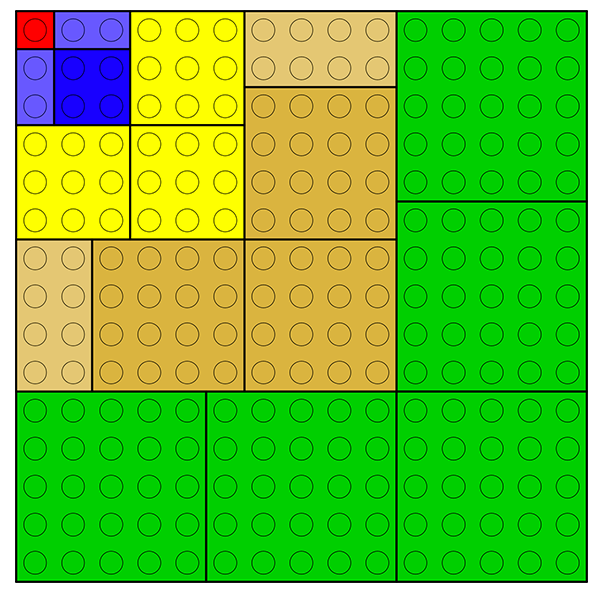
The area of these plates from a famous construction toy
equals the square of the sum of the integers from 1 to 5.
By stacking them according to color, we can also build cubes with side lengths from 1 to 5.
The same approach proves that 2025 is the sum of the cubes from 1 to 9.
2025 is also reminiscent of Fermat’s two-square theorem, also known as the Christmas theorem because the Toulouse magistrate discussed it at length in a letter to Father Mersenne dated Christmas 1640. The theorem states that an integer is the sum of two squares if and only if each of its prime factors of the form 4k + 3 occurs with an even exponent.
Here, 2025 = 34 × 52, so the conditions are met. Carl Gustav Jakob Jacobi (1804–1851) later gave a formula for the number of ways to express an integer as a sum of two squares; for 2025, there is only one:
2025 = 272 + 362. If we allow ourselves to add a few more squares, 2025 has yet another property: it is the smallest square that can be written as the sum of 17 distinct squares.
Can you find such a decomposition?
As a hint, you may use the square of 23.
In Kaprekar’s work
------------------------
2025 also appears in the work of the Indian mathematician Dattatreya Ramachandra Kaprekar (1905–1986), whose research in arithmetic was popularized by Martin Gardner. Kaprekar took an interest in numbers he called harshad (“giving joy” in Sanskrit), which are divisible by the sum of their digits. This is indeed true of 2025, which is divisible by 2 + 0 + 2 + 5 = 9.
As we have often seen here, part of the interest of 2025 stems from the fact that it is the square of 45. As it happens, 45 is a Kaprekar number. This means that its square can be split into two numbers whose sum is 45 itself.
452 = 2025 and 20 + 25 = 45. The next years to exhibit this property are 3025, 9801 and 88209; for the last of these, (88 + 209)2 = 88,209.
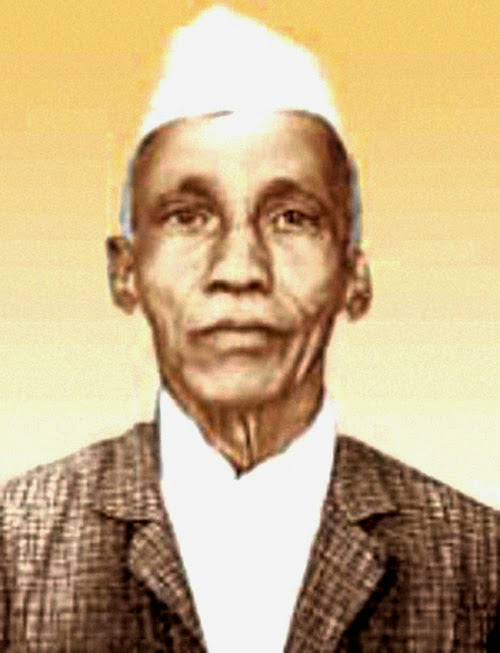
Dattatreya Ramachandra Kaprekar.
Questions in discrete geometry
-----------------------------------
Let’s now leave arithmetic behind and turn to discrete geometry or combinatorics. Begin with a square and divide each side into n equal line segments. This gives 4n points arranged in a square. Join each point to the one n + 1 positions farther along. Since a picture is often worth a thousand words, take a look at the attractive pattern obtained for n = 3. It contains 37 regions.
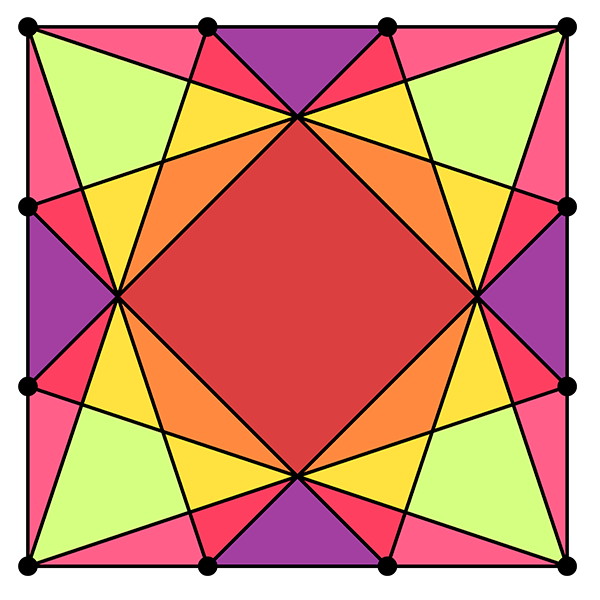
And with n = 22? We get 2025 regions, of course! Be warned: analyzing the general case is not so simple.
Have you ever wondered how a disk might be represented in a pixelated image? Here is one possible method. Consider a grid of small squares. If we draw a circle of radius 5 centered at the center of one of the small squares, that circle contains 61 small squares.
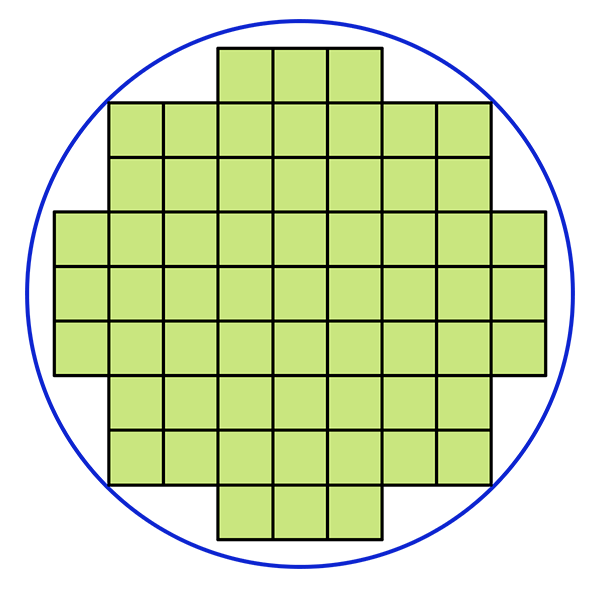
A circle of radius 26 contains 2,025 unit squares! A little coloring exercise should convince you!
The number 2025 also lies hidden in an elegant graph-theory puzzle. Place four points in the plane and join every pair. This gives the complete graph of order 4, denoted K4. How many crossings have you created? If you arrange the points carefully, perhaps none at all—for example, by placing one point inside the triangle formed by the other three.
Now try the graph K5. It can be drawn with just one crossing, but no fewer. For K6, the known minimum is three crossings, while for K7 it is nine. Proving even these first results is far from straightforward.
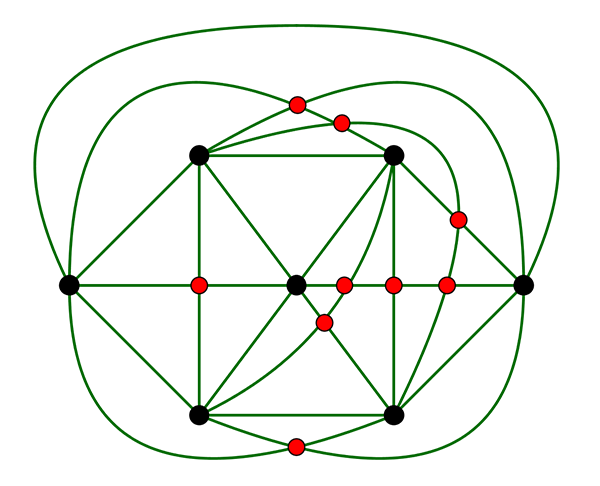
A drawing of K7 with nine crossings (in red).
It can be shown that no drawing has fewer crossings.
All values are known up to K14, but beyond that nothing is certain. For K21, the minimum is conjectured to be 2,025 crossings. Who will manage to prove it? We may not know before the end of the year, but let's hope it will be a very happy one for all our readers!