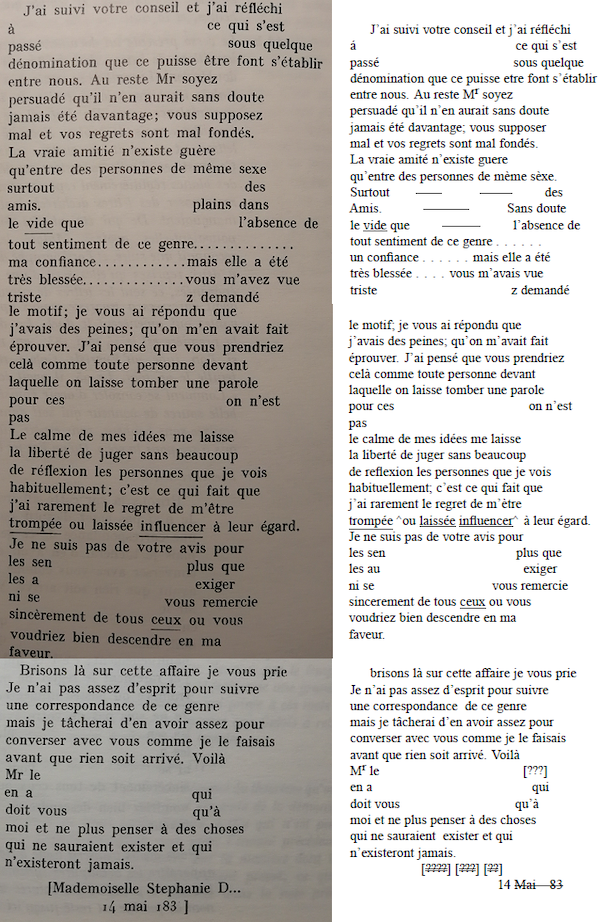
On one sheet of his manuscripts, now held at the Institut de France Library, Évariste Galois wrote a series of sentences containing a number of mysteriously arranged "gaps" (see below).
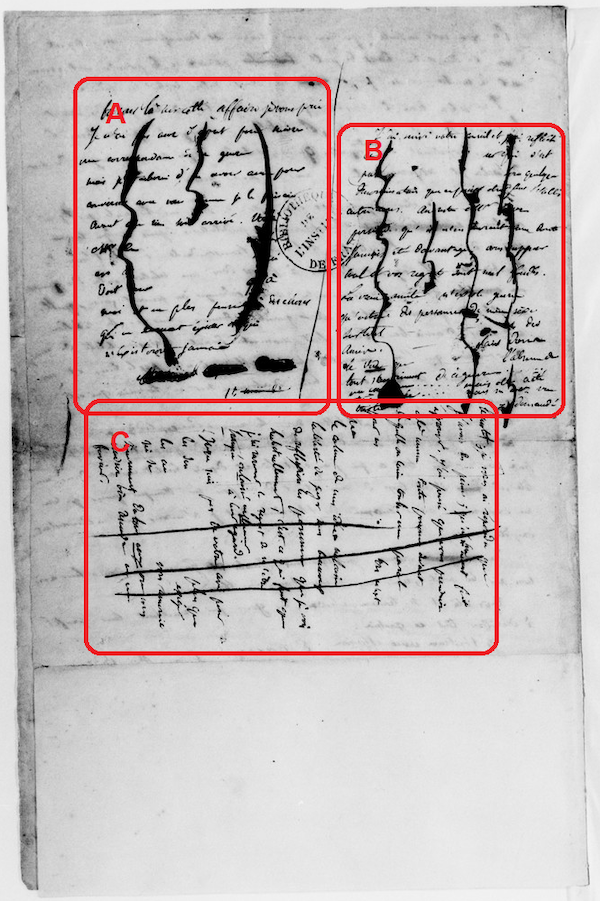
A mysterious message arranged in three blocks, labeled here A, B and C.
Missing words leave gaps in the center of block A,
and at the top and bottom of blocks B and C. © anqian
These gaps are not just anywhere: they appear on the back of the final sheet of the famous letter Galois wrote on the eve of the duel that would cost him his life. In this "scientific testament," he reviewed his mathematical research one last time. Nor do the words seem innocuous. The phrase "Let's leave it at that in this matter" unmistakably refers to a break. Several contextual clues suggest that this break may have been romantic in nature, perhaps expressed by a certain Stéphanie, whether or not it was connected with the duel.
Taking on the text
-------------------
The text consists of three blocks, A, B and C. Probably because block A ends with a date, the editors of Galois's manuscripts always assumed that they were looking at a partial copy (or reconstruction) of two letters: one comprising block A, the other blocks B and C. In fact, it is a single letter, which must be read in the order B–C–A, not A–B–C.
Anqian noticed that the curious arrangement of the gaps left by the missing words matched the damage a flame would inflict on the original letter when properly folded (see below).
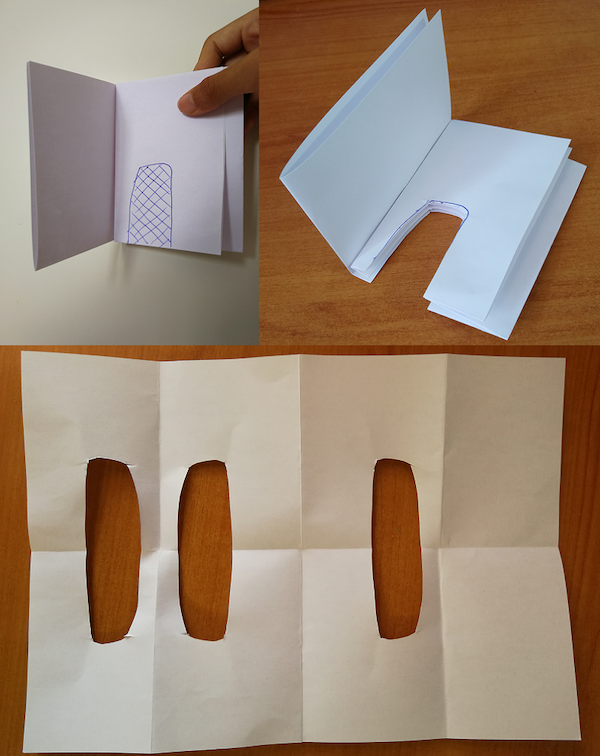
Simulation of a flame's effect on the properly folded letter.
The holes correspond roughly to the gaps in Galois's copy. © anqian
Galois would therefore have begun burning the original letter, perhaps changed his mind—at least for a time—and then, for some particular reason or simply out of idleness, copied the words that remained legible in their original arrangement.
The letter with a strip cut off
Another careful observation enabled anqian to correct a further misconception among Galois's editors: they believed that the copy had been made before the famous final letter on the front of the sheet was written. In their view, Galois had begun writing on the sheet without realizing that its back had already been used as scrap paper. Yet the reverse is (probably) true!
A strip had in fact been cut from the bottom of the sheet—and not just anywhere, but immediately after the end of the final letter on the front. Galois finished that letter without any noticeable change in his handwriting and without crowding the words together, as he might have done had he known that he was about to run out of space. On the back, by contrast, Galois begins copying block C—the block most likely to reach the bottom of the sheet—as close as possible to the opposite edge, as though he knew that space was limited this time.
The strip would therefore have been cut away after the final letter was completed but before the breakup letter was copied. On the eve of the duel, then, after writing his intellectual testament, Galois cuts a strip from the bottom of the final sheet, turns it over and copies a half-burned letter. Why? That remains a mystery!
Other aspects of the letter itself remain puzzling, not least the missing words that have yet to be guessed.