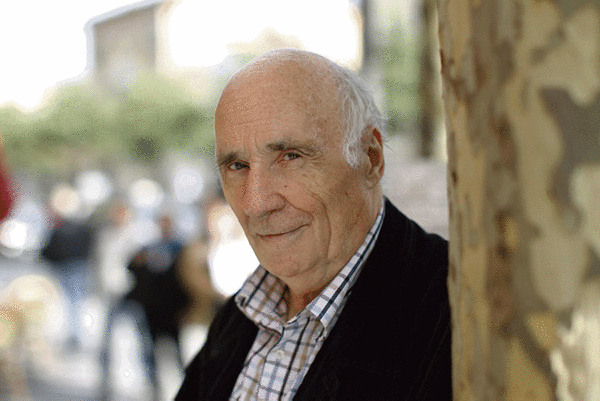
Alongside the Goncourt Prize for Literature awarded to Hervé Le Tellier for L’Anomalie (Gallimard, 2020, see Tangente 198), the Goncourt Prize for Poetry–Robert Sabatier was awarded on May 4 to Jacques Roubaud for his entire body of work.
A true mathematician, Jacques Roubaud defended his 1967 thesis on "Rational and algebraic morphisms in types of one-dimensional discrete A-algebras" and then served as a university professor until 1991. He describes himself as a "composer of mathematics and poetry".
Jacques Roubaud has learned thousands of lines of poetry by heart, studied every genre from medieval literature to the works of Lewis Carroll—including his translation of *La chasse au Snark (Gallimard, 2010)—and authored more than a hundred books. Chosen by Raymond Queneau to join Oulipo (Ouvroir de littérature potentielle) in 1966, he is also an influential Go player who published a treatise on the game with Georges Perec. Above all, he is drawn to writing governed by mathematically derived constraints, especially combinatorial ones. His fondness for numbers is particularly memorable: the permutations of the sestina* (a fixed poetic form comprising six six-line stanzas whose line endings are determined by permutations; see our feature "Maths et poésie," Tangente 130, 2009); the 317 remarks in each section of his Poétique. Remarques (La Librairie du 21st Siècle, 2016), because 317 is prime, as is its palindrome, 713…; and books with numbers in their titles, such as *Trente et un au cube* (Gallimard, 1973), 128 poèmes (Gallimard, 2001), and Ode à la ligne 29 des autobus parisiens (Le Tripode, 2012)… Also memorable is his novel *Mathématique* (Le Seuil, 1997), in which he minces no words when recalling his dismay as a student faced with
"modern mathematics," into which most of his fellow students "felt themselves falling without a parachute, into hostile territory". Nor should we forget his serial "Pythagore," produced in 2001 for France Culture to celebrate the preceding year, the World Mathematical Year (proclaimed by UNESCO).