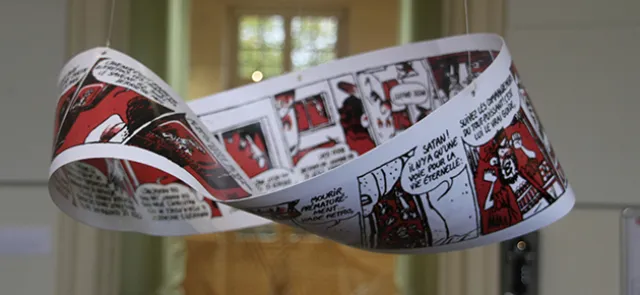
Title inspired by A Convergence of Lives: Sofia Kovalevskaïa...* Ann Hibner Koeblitz. 1993.
As a mathematician, Michèle Audin naturally published research and teaching articles intended for a specialist readership. Her efforts to reach a wider audience by popularizing mathematics were equally remarkable. Examples include her contributions to the CNRS journal Images des mathématiques, which can also be found on her personal website.
"To be a mathematician, one must be, to a certain extent, a poet", said the celebrated mathematician Karl Weierstrass (1815–1897). Both mathematics and poetry are languages that require imagination to express beauty. But that "certain extent" is decisive. Few people are both scientists and prolific writers.
Michèle Audin loved history: the history of mathematics and mathematicians, of well-known men and women, as in Correspondance entre Henri Cartan et André Weil (1928-1991), published by the Société mathématique de France in 2011; but also the history of people whom official narratives would have preferred to erase, such as her own father, portrayed in Une vie brève (Gallimard), published in 2013. In Comme une rivière bleue (Gallimard, 2017), Mademoiselle Haas (Gallimard, 2016), and other works, she recovers the stories of forgotten people, often forgotten women—the women workers in the background of tragic events such as the Paris Commune of 1872. Stories within history.
From Sofia to Oulipo
Nearly a century before Michèle, there lived another woman with similar scientific interests: Sofia Kovalevskaïa, who was also a writer—and a nihilist to boot. Sofia's life was admittedly more dramatic: the age in which she lived forced her into a marriage of convenience so that she could study abroad, inequalities were more firmly institutionalized, and diseases were deadlier.
Michèle Audin forges a symbolic bond, retracing the footsteps of "our Sophie" with insight and tenderness in Souvenirs sur Sofia Kovalevskaya (Calvage et Mounet), published in 2008. The book gives a rigorous account of her mathematical contributions and portrays her scientific and political milieu. It also contains literary pastiches entitled "pauses." In particular, Michèle draws inspiration from Cosmicomics by Oulipo member Italo Calvino (1923–1985), whose main character bears the unpronounceable palindromic name "Qfwfq," to describe Sofia Kovalevskaïa's research on Saturn's rings. She adopts the style of Georges Perec (1936–1982) in Je me souviens (Hachette, 1978) to recreate the many comments, whether glowing or caustic, prompted by Sofia as a woman and a mathematician.
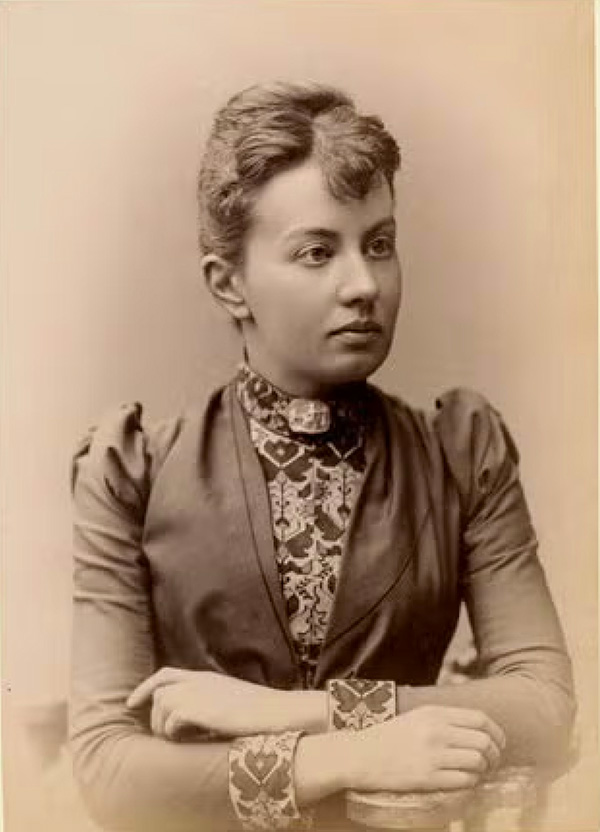
Sofia Kovalevskaïa (1850–1891).
This book led to Michèle Audin becoming a member of Oulipo in 2009. Oulipo—the Ouvroir de littérature potentielle—was founded in 1960 by Raymond Queneau and François Le Lionnais. The movement was influenced by the Bourbaki group, formed in 1935 to place mathematics on solid foundations. Oulipo members sought to bring the same collective spirit to their work, to encompass the entire field of literature as Bourbaki had done with mathematics, and to inject mathematical concepts into literary creation.
Michèle Audin was co-opted into the group by Jacques Roubaud (1932–2024), another mathematician and Oulipo member. In accordance with Oulipo tradition, she remains a member, permanently excused from meetings on account of her death.
Constraints, mathematical or otherwise, are the essence of Oulipo. Whether applying them produces literature is another matter. The process is not automatic! In her own words, becoming a full-fledged member of Oulipo gave her the legitimacy to write about something other than mathematics. In fact, Michèle had felt intellectually akin to Oulipo since the age of twenty-four, when she came across Perec's La vie mode d’emploi (Hachette, 1978) in a bookshop.
Michèle follows in her predecessors' footsteps by introducing new constraints into Oulipo, including geometry. One example is Pascal's theorem in Mai quai Conti, written in 2011 and published online on the Oulipo website after fifteen publishers had rejected it. At the meetings of the Académie des sciences on Quai Conti, held every Monday from March 13 to June 5, 1871, the meeting room becomes the ellipse; six points become six academy members forming the vertices of a hexagon inscribed in the conic; and a line containing three points becomes a relationship among the people concerned. The theorem's conclusion reveals an unexpected relationship among the academy members.
On the use of sestinas
Michèle Audin explains the poetic form of her novels as a way of distancing herself from and "containing" painful emotions. In Comme une rivière bleue (Gallimard, 2017), she describes the massacres of the Paris Commune's final week, day by day, in the form of a pantoum: its stanzas consist of four lines, with the second and fourth lines of each stanza repeated respectively as the first and third lines of the next.
1. she remembers 2. she sees,
3. she imagines 4. she hears
1. she sees, 2. she feels,
3. she hears, 4. she sees again
etc.
After that, it is just a matter of filling in the boxes!
In this text, as in several others, sestinas—and, more generally, queninas—appear. These poems have fixed rhyme words—that is, the words at the end of each line—for every stanza, while the order in which they appear follows a given permutation. The arrangement structuring these poems is a spiral permutation. From one stage to the next, the objects in the second half of the interval are interleaved in decreasing order among those in the first half.
In mathematical terms, for a set En = {1, 2,…, n}, where n is an integer, the spiral permutation σ: En → En is defined by
When n = 6, poems written using this permutation σ are called sestinas. They were devised by Arnaut Daniel, a 12th-century troubadour. In the translation of his famous poem Ongle et Oncle, found in the article Poésie, spirales et battements de cartes on the Images des mathématiques website, the rhyme words are as follows: enters, nail, soul, rod, uncle, room. They are permuted according to the rule described above. Thus, replacing the words with the digits 1 to 6, we can check that:
σ (1, 2, 3, 4, 5, 6) = (6, 1, 5, 2, 4, 3)
σ (6, 1, 5, 2, 4, 3) = (3, 6, 4, 1, 2, 5)
σ (3, 6, 4, 1, 2, 5) = (5, 3, 2, 6, 1, 4)
σ (5, 3, 2, 6, 1, 4) = (4, 5, 1, 3, 6, 2)
σ (4, 5, 1, 3, 6, 2) = (2, 4, 6, 5, 3, 1)
Then, with σ 6 (that is, after applying the permutation six times), we recover the original ordering. A sestina is thus a poem comprising six stanzas of six lines.
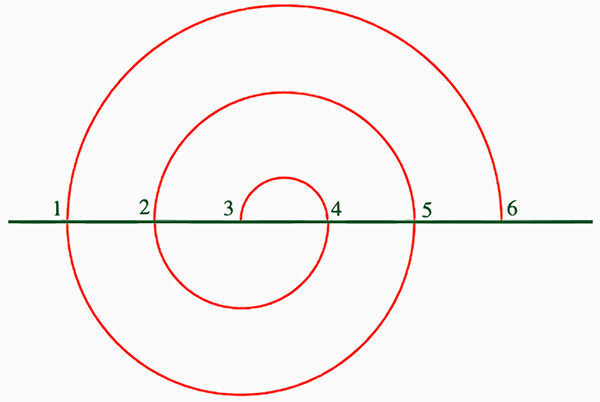
In La belle Hortense (Ramsay, 1985), Jacques Roubaud uses this form and alludes to snails.
A natural question is which integers n have the property that the spiral permutation of (1, 2, ..., n) has order exactly n. Recall that the order of a permutation σ of n elements is the smallest integer m such that σ m is the identity. Such numbers are called Queneau numbers, while poems composed as cyclic permutations, with n stanzas of n lines each, are called quenines.
When is n a Queneau number? It can be shown that 2n + 1 must be a prime number p. This condition is necessary but not sufficient. For example, there is no septine, since 15 is not prime, but there is no octine either. In fact, Queneau numbers can be characterized by studying the fields ℤ/pℤ: these are sets whose elements are the remainders obtained upon division by a prime p, and on which addition and multiplication can be defined naturally. Questions of this kind remain relevant today.
Michèle Audin was interested in structures rather than numbers. Her novel Cent vingt et un jours (Gallimard, 2014) has the semantic structure of an onzine. It consists of eleven chapters, each featuring the same eleven items (112 = 121). Moreover, the last sentence of each chapter becomes the first sentence of the next.
A sestina structure underlies her book Une vie brève, which describes in six headings and six chapters the circumstances surrounding the short life of a young communist—her father, Maurice Audin, who was murdered at the age of 25 by the French army in Algeria. Each chapter contains material from these six headings, ordered according to the spiral permutation.
Several Oulipians, notably Ian Monk (1960–2025) in Le monde des nonines (2015), revived nonines, numbers that are not Queneau numbers. For the non-Queneau number 4, Michèle Audin, inspired by Jacques Roubaud’s Le Conte du Labrador (1981), constructed a metatext about four writers producing a book together in sixteen days according to a rule that defines an Abelian group operation (An Abelian group is a set equipped with an associative, commutative binary operation. It has an identity element, and every element has an inverse). The order of the chapters forms the following magic square, in which the numbers in every row, every column and both diagonals add up to 34:
| 6 | 12 | 9 | 7 |
|---|---|---|---|
| 15 | 1 | 4 | 14 |
| 3 | 13 | 16 | 2 |
| 10 | 8 | 5 | 11 |
In Le cahier des charges de la Vie mode d’emploi (1993), Perec explains that this is how he constructed a pair of orthogonal Latin squares of order 10 (again, not a Queneau number).
Mathematician
Michèle Audin’s mathematical writings are intended for readers from a wide range of backgrounds—students, teachers, researchers and others. Her research lies in the field of symplectic geometry. The word "symplectic" (from the Greek sumplektikos, meaning "intertwining") was introduced by the German mathematician Hermann Weyl (1885–1955) around 1936, but its origins can be traced back to Lagrange’s work (1736–1813) on planetary trajectories. Emerging from mechanics and Hamiltonian optics, the subject intertwines several areas of contemporary mathematics, chiefly differential geometry and the study of dynamical systems.
Among other things, Michèle Audin was a specialist in integrable systems. These are systems of differential equations with enough conserved quantities, such as energy, that their motion can be described as a function of time. Their behavior is regular and predictable, unlike that of chaotic dynamical systems. Two examples are the motion of a rigid body rotating about a fixed point, a problem studied by Euler and Lagrange and known as Die mathematische Nixe ("The Mathematical Mermaid"), and the Lagrange top, a symmetric top with an axis of symmetry.
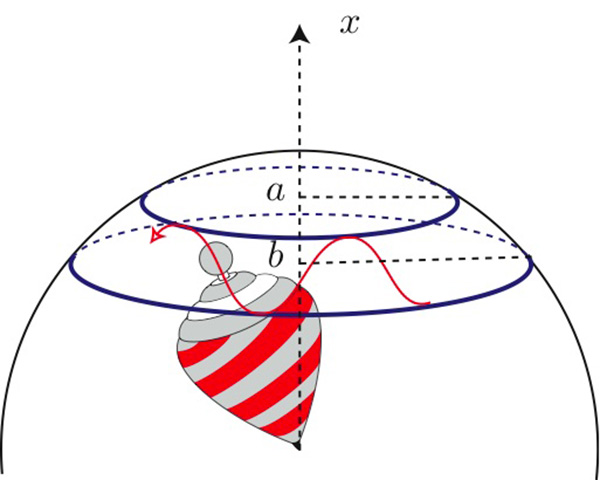
Nutation, the periodic motion of the top’s axis of rotation about its mean position.
In 1889, Sofia Kovalevskaïa studies integrable systems using complex variables. She seeks to represent their solutions as meromorphic functions (in one complex dimension, a meromorphic function is holomorphic except at a discrete set of points where it has poles, or isolated singularities).
She proves that this is possible in only three cases: the two systems of Euler and Lagrange mentioned above, and what is now called the Kovalevskaya top. For mathematical details, see, for example, Michèle Audin’s article Le cas de Sophie Kowalevski (Tangente 109, 2006).
In modern terminology, these are examples of algebraically completely integrable systems. They arise in other mathematical contexts, including group theory, the study of algebraic curves and differential Galois theory. Some of Michèle Audin’s research lies at the intersection of these fields.
"Menschen sterben, die Gedanken bleiben" ("People die; ideas remain"), Karl Weierstrass said of Sofia Kovalevskaïa. The words apply equally well to Michèle Audin, whose work, carried out with such rigor and heart, will endure.
Gautami Bhowmik is a lecturer and researcher at the Université de Lille and a member of the Femmes et mathématiques association.