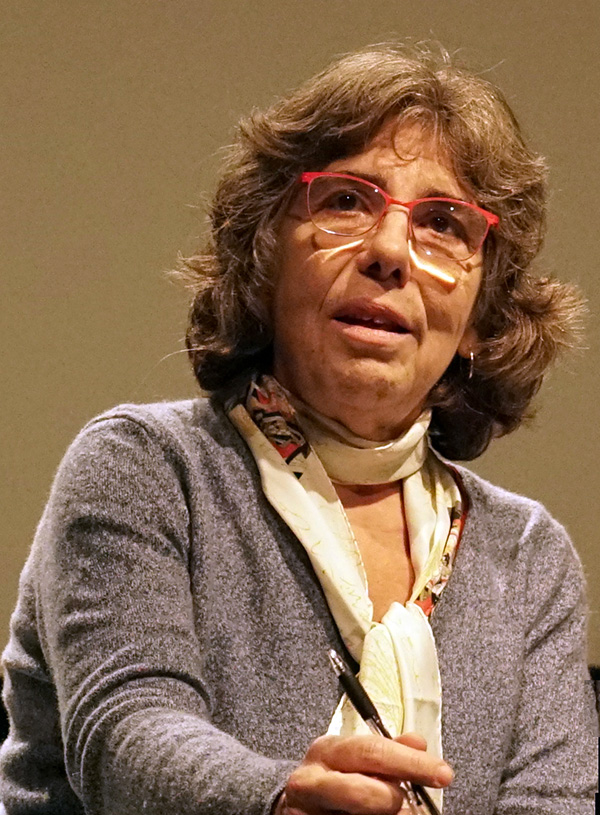
Deeply involved both in promoting mathematical culture and in literature, with several novels to her name, she was also a member of the Ouvroir de littérature potentielle (Oulipo). A tireless advocate for women in mathematics, she served as president of the association Femmes et mathématiques from 1990 to 1991. Passionate about history, particularly the Paris Commune (1871), she published numerous books on the subject. Her final book, La maison hantée, is set during the Second World War. She devoted a book, Une vie brève, to her father, Maurice Audin, himself a mathematician, who was abducted and murdered by the French army in Algeria in 1957 and in whose memory she declined the Legion of Honour offered to her in 2009.
Discover Michèle Audin's work
----------------------------------
Here are a few excellent recommendations (presented in order of increasing mathematical content) for discovering Michèle Audin's literary work and gaining a feel for her sensibility, memories, struggles and anger…
\ La maison hantée*, Les Éditions de Minuit, 2025. The narrator, a librarian who is the author's fictional double, uncovers the history of her apartment and of rue Dunat-Diehr. We follow the Strasbourg residents expelled from the city at the beginning of the war, those allowed to return under the occupation and those tossed about by the war. This novel reveals a little-known side of Alsatian history.
\ Une vie brève*, Gallimard, 2013. A deeply moving account of what the twenty-five years of her father Maurice Audin's life (1932–1957) must have been like before it was brutally and unjustly cut short.
\ Oublier Clémence*, Gallimard, 2018. A short text paying tribute to an anonymous female worker and to all those anonymous people forgotten by history.
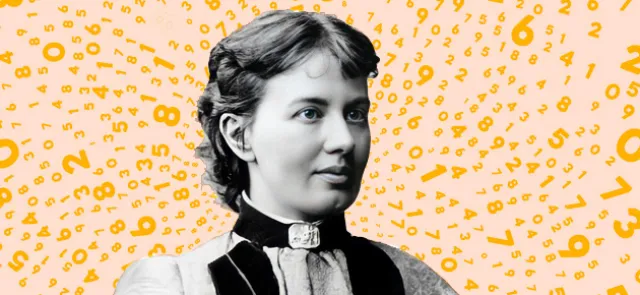
\ Souvenirs sur Sofia Kovalevskaïa*, Calvage et Mounet, 2008. Michèle Audin presents the mathematician Sofia Kovalevskaïa (1850–1891) by interweaving biographical details, her mathematical work (including an uncompromisingly detailed account of her research on partial differential equations) and the progressive convictions of this rebel.
\ La formule de Stokes*, Cassini, 2016. The first novel whose hero is a formula. We work our way through the calendar, day by day, while roaming across the centuries and encountering stories about Stokes' formula: its historical discovery, its applications and even, in a delightful mise en abyme, the writing of this very book. An Oulipian and mathematical novel!
\ Fatou, Julia, Montel*, Springer, 2009. Michèle Audin examines the lives of Gaston Julia, Paul Montel and the lesser-known Pierre Fatou, their contributions to the study of iterated rational functions, their conflicts... and the recognition that followed from this research. A wonderful introduction to the mathematics of the first half of the 20th century.