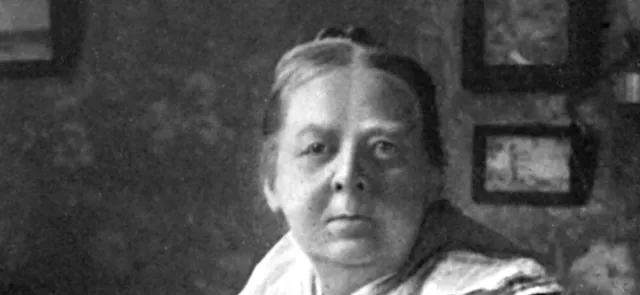
Born in Moscow, Sofia Kovalevskaya (1850–1891) was the first woman to receive a doctorate in mathematics from a German university. Her name remains particularly associated with the Cauchy–Kovalevskaya theorem and the equation for the Kovalevskaya top. Yet she was initially far more interested in poetry, as she wrote in her Souvenirs d’enfance:
"The rhythm of verse has always exerted such a powerful charm over me that I was writing poetry by the age of five. My governess thoroughly disapproved of this sort of pursuit: she had formed a very definite picture in her mind of a healthy child raised under normal conditions who would, in time, become an exemplary young lady, and Russian verse had no place in this ideal. She therefore vigorously persecuted my poetic inclinations: if a scrap of paper scrawled with my rhymes had the misfortune to catch her eye, she would immediately pin it to my back and then recite my poor literary efforts in front of my brother and sister, distorting or mangling them to her heart’s content.
This persecution had no effect. By the age of twelve, I was inwardly convinced that I had been born a poet. My fear of my governess prevented me from writing down my verses, so I kept them in my memory, like the bards of old, and entrusted them only to my ball. As I run across the great hall, throwing it ahead of me, I sometimes declaim to it two of my favorite works, of which I am very proud […].
But the Muse is capricious, and inspiration does not always come at the appointed hour for playing ball; and if the Muse does not answer my call, my situation becomes perilous, for I am surrounded on all sides by temptation. Next to the hall is the library, where enticing little volumes of foreign novels and issues of Russian magazines lie scattered over every sofa and table. I am strictly forbidden to touch them, for my governess is very severe about my reading. […]
I wrestle with myself for a few minutes. I approach a book and merely open it… I leaf through it and read a few sentences; then I quickly resume running with my ball as though nothing had happened… But little by little, the book draws me in: my first attempts having met with success, I eventually forget the danger and devour page after page. […] From time to time, however, I prudently throw my ball so that, if my governess should return, she will hear me playing as instructed.