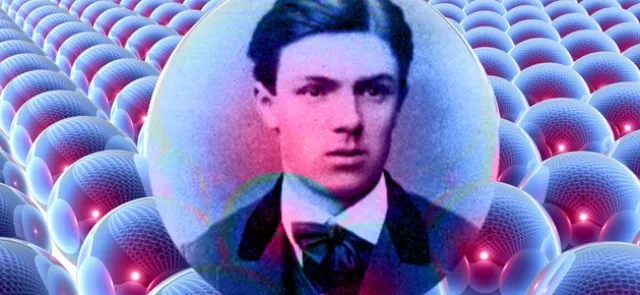
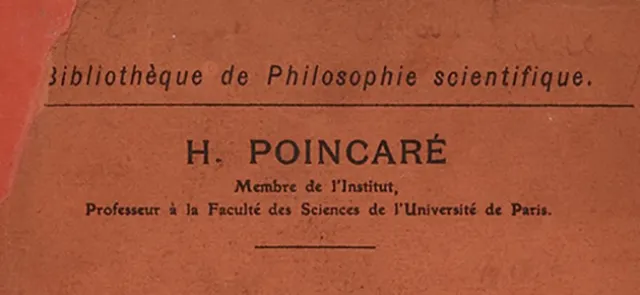
Poincaré's writings on mathematical discovery have inspired a considerable body of interpretation. His text Mathematical Invention (Science et Méthode, book one, chapter 3, Flammarion, 1908) has become an essential reference. Less well known, however, is the clinical study of his intellectual approach written by Dr Toulouse, a renowned psychiatrist of the early 20th century (see box).
A clinical analysis
--------------------
The physician sought to map human genius and explain the process of invention. Henri Poincaré was the ideal candidate. From this perspective, the introductory remarks are illuminating: "Mr Poincaré is the quintessential speculative thinker, with little interest in anything beyond the work of thought […]. He has never enjoyed physical exercise (except walking, which is automatic), games (even as a child), or, more generally, anything involving practical life." He concluded: "The period of voluntary attention [is particularly short in Mr Poincaré] when his interest is not strongly engaged." Although this clinical analysis must be treated with great caution, and although early-20th-century psychology was still steeped in prejudice, Dr Toulouse painted a "fairly accurate" portrait of Poincaré's mind: his powers of abstraction, his relationship with external reality, his relationship with his body, and the nature of his attention. Everything is encapsulated in a single sentence. The psychiatric analysis highlights central issues—crucial questions for any attempt to define the boundaries of creative activity (which the clinical analysis itself does not attempt). Poincaré, who accepted the principle of this experimental study, did not really dispute the psychiatrist's conclusions. His writings on the mathematical mind support this interpretation of the psychology of invention.
One of the fascinating features of Poincaré's reflections is that their author is both the subject and the object of his own thoughts. The opening lines of Mathematical Invention could hardly be more explicit. Poincaré wrote: "The genesis of mathematical invention is a problem that should be of the keenest interest to the psychologist. It is the act in which the human mind seems to borrow least from the external world, in which it acts, or appears to act, only by itself and upon itself." Poincaré's interest extended beyond mathematics: through introspection, he sought to penetrate the mystery of the human soul and understand how concepts are formed and how the power of thought attains autonomy. But Poincaré's initial question when writing Mathematical Invention concerned the mechanism of error—or, more precisely, how to explain why some minds are better equipped than others to solve mathematical problems.