Who were the first women mathematicians in history? Obviously, we do not know: a distinction must be drawn between the first person in human history to do something and the first person known by name to have done it. So let us rephrase the original question: who were the earliest women mathematicians in history whose names have survived?
Theano
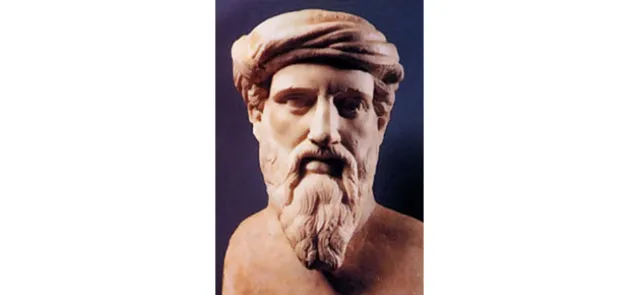
Theano (6th–5th centuries BC) is often cited as the earliest woman mathematician whose name has come down to us. But who was Theano? We do not really know: while some Greek sources describe her as Pythagoras's wife, others make her the wife of Brontinus, a member of the Pythagorean sect. There may even have been two different women. What immediately stands out is that the Theano believed to have been a mathematician was evidently one only through her connection with a man. This is a very common pattern: being the "daughter of" or "wife of" someone was generally the way to gain access to an education traditionally denied to women (see the article "Categorizing women in science in the 18th century").
When Theano is regarded as Pythagoras's wife, she is also thought to have taken over the leadership of her late husband's school (as Tommaso dell'Abaco's wife apparently did in 1330; see the article "The Middle Ages: between representations and reality"). Thus, she is presumed to have been a mathematician both because she married one and because she subsequently carried on his work.
But first, there is no evidence that Pythagoras did much mathematics during his lifetime. He was clearly a philosopher, with a pronounced interest in political philosophy: at the very least, he served as the power behind the government of Croton in southern Italy. He certainly took an interest in mathematics, but apparently for metaphorical purposes above all, and there is no indication that he conducted any mathematical research himself. The theorem bearing his name was not his work (nor did he ever claim that it was), and he probably saw it less as a geometric property on which to base mathematical exercises than as an arithmetical one—the possibility of decomposing one square into two squares—revealing the unity of the world through numbers. It is therefore far from certain that Theano was a mathematician merely because she was Pythagoras's wife.