Cauchy and the arithmetic–geometric mean inequality
----------------------------------
In his 1821 work Analyse algébrique, Augustin-Louis Cauchy (1789–1857) states the following theorem: "The geometric mean of several numbers A, B, C, D… is always less than their arithmetic mean."

In other words, in his notation:
His proof is laborious, and the underlying reason for this property is the convexity of the function
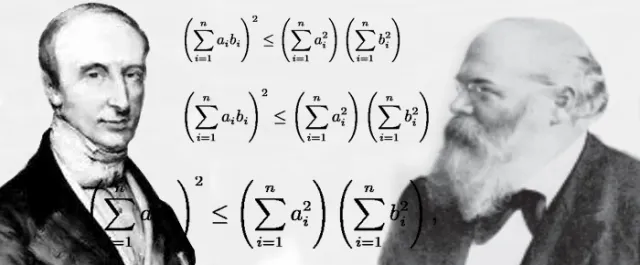
In an article published in 1888, Leonard James Rogers (1862–1933) showed how to prove many other inequalities "by a slight extension of the well-known theorem concerning the inequality between the geometric and arithmetic means of n positive numbers". The British mathematician then generalized the inequality proved by Cauchy to weighted means. More precisely, he proved that if a1, a2… *an and b*1, b2… *bn* are positive quantities, then:
Setting all the *ai* equal to 1 recovers the arithmetic–geometric mean inequality. Rogers used this result to prove various inequalities, including some involving integrals via Riemann sums, as well as an inequality attributed, most unjustly, to Hölder.
Hölder comes close
------------------

In a paper published in 1889, Otto Ludwig Hölder (1859–1937) considered a function φ whose derivative is strictly increasing and proved that the weighted arithmetic mean of the values of φ at arbitrary points is strictly greater than the value of the function at the point corresponding to the weighted arithmetic mean of those points. After reading that sentence three times, you'll be ready for the following formula:
Taking n = 2 and a1 + a2 = 1 recovers the usual definition of a convex function, except that Hölder worked with strict inequalities. The German mathematician used the mean value theorem to prove his formula for n = 2.
The German mathematician then proved several inequalities using the convexity of the exponential function and the concavity of the logarithm function.
A definition at last!
----------------------
January 17, 1905, could be regarded as the birth date of the concept of a convex function. Admittedly, before then, some had used properties of convex functions to prove inequalities; but on that day, the Danish mathematician Johan Jensen offered an initial definition in a lecture to the Danish Mathematical Society.
In his own words (he wrote in French), "when a real, finite, single-valued function φ of the real variable x satisfies the inequality φ (x) + φ ( y) ≥ 2 φ((x + y)/2) on an interval, we call φ convex on that interval."
Jensen's definition is more general than the one used today, since it corresponds to the case α = 1/2 of the standard definition (see the article "Useful functions in analysis"). In particular, a function that is convex in Jensen's sense need not be continuous; using the axiom of choice, the German mathematician Georg Karl Wilhelm Hamel (1877–1954) gave an example of a discontinuous function g satisfying, for all real numbers x and y, g (x) + g (y) = g ((x + y*)/2), and hence convex (and concave).
Soon afterward, in 1920, Wacław Franciszek Sierpiński (1882–1969) proved that a convex function that is Lebesgue measurable—a property shared by a "very broad" class of functions—is necessarily continuous, except perhaps at the endpoints of its domain.
It is worth noting that Georg Hamel was an ardent supporter of Nazism, the appalling ideology that victimized Sierpiński and many of his colleagues…