"Mathematics is everywhere," we often hear, sometimes followed by "for better or worse." Unfortunately, that "worse" is invoked all too often, with mathematics portrayed as a source of disaster: in economics and finance (that perennial favorite), in demography and in epidemiology, where mathematical models are blamed ad nauseam. These days, mathematics is accused at every turn. But should we not be targeting the way it is used rather than mathematics itself?
-
Mathematics under fire in "Le Monde"
------------------------------------
Yet even the most respected voices join the ignorant and the malicious in exploiting this confusion to sow doubt. We shall not revisit Michel Rocard's 2008 diatribe, in which he came close to accusing mathematics teachers of a "crime against humanity."
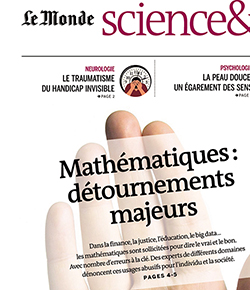
The daily newspaper "Le Monde" ran a special report under the provocative—or perhaps "sensationalist"?—headline "Maths Runs Wild" (16 September 2015). The report was almost entirely an indictment of mathematics, blaming it from the outset for every conceivable ill: the break-up of a Mars probe "because of a metric-unit error" in 1999; soaring unemployment and national debt since 2008 following the bursting of "financial bubbles sustained by dubious equations"; the "almighty algorithms [that] overestimated the late-2012 [flu] epidemic in the United States by almost a factor of two"; the IMF's January 2013 underestimation by half of "the effect of budget cuts on growth in crisis-stricken countries"; and "around ten miscarriages of justice attributed to incorrect probability calculations." Enough already!
After this carefully orchestrated indictment, the "Le Monde" report nevertheless qualified its claims, pointing out how readily use can slide into misuse. It gave detailed examples of how mathematics has been "misappropriated" in certain fields. This amounted to a veritable hijacking of the legacy of logical reasoning, the power of deduction and the scope for modelling that this science provides.
But the damage was done! It gave ammunition to those only too eager to disparage mathematics with fallacious arguments. And there is a further danger: young people being "steered away" from mathematics! One more contribution to the shortage of scientists—a danger whose gravity we have yet to grasp.
-The real misuses, from Dreyfus to climate change
---------------------------------------------
There is nothing wrong with using mathematics to justify one's opinions; making mistakes is another matter!
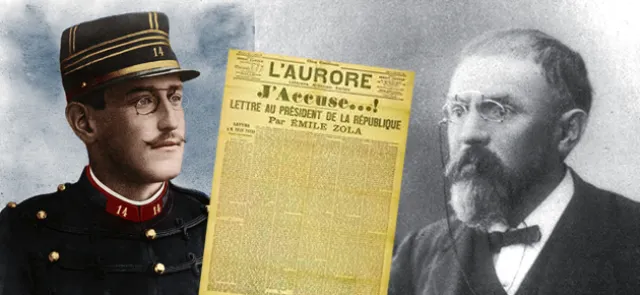
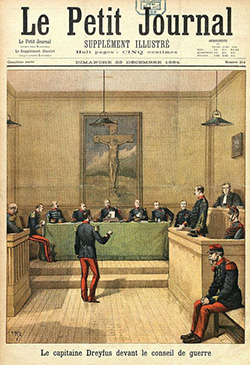
Alphonse Bertillon was perfectly entitled, when arguing that Captain Dreyfus was guilty both in 1894 and during the 1899 retrial, to use a geometric method in an attempt to identify Dreyfus's handwriting, or probability calculations to estimate the possible number of matching words or syllables appearing twice in the "bordereau" supposedly incriminating Dreyfus. What he was not entitled to do was get the method wrong: he calculated the probability of four letter matches out of 26 as 0.24, rather than using the probability calculated by Poincaré from a binomial distribution with parameters (26, 4), which was almost 400 times greater!
There is nothing wrong with using statistical weighting to compile the "Shanghai ranking" of
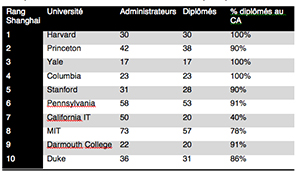
universities worldwide, or with believing its official description, which states that it "uses carefully selected objective criteria," "is based on comparable international data that anyone can verify" and "involves no subjective measures." It would, however, be wise to question the relevance of the chosen criteria, whether they are weighted objectively, the failure to publish the original data and the impact of the time factor—both the duration of a project and the date on which certain distinctions were awarded to members of the academic staff at the universities concerned.
Nor is there anything wrong with using computer algorithms to reproduce the complexity of the world and thereby model climate phenomena, or with devising a battery of tests to check that the simulated climate agrees with observations. What matters, however, is retaining a critical perspective on reports such as that of the IPCC (Intergovernmental Panel on Climate Change). Admittedly, the panel used around twenty so-called "global circulation models" (GCMs), ordinarily the most reliable models available. Expressed as systems of differential equations or partial differential equations, however, these models are complex; their selection is sometimes empirical, and they cannot account for the excessively large number of parameters influencing climate change. All this makes it difficult to narrow the uncertainty ranges. In his book "Le mythe climatique" (The Climate Myth; Le Seuil, Science Ouverte, 2010), Benoît Rittaud even highlights weaknesses in the panel's statistical analysis, noting the sparse and uneven distribution of measurement points, errors in the famous "hockey-stick curve" representing changes in temperature, the sometimes overly biased choice of reference points used to plot the curves, and the dubious extrapolation of certain models over time.
-
When we choose the model that suits us
-------------------------------------------
Do mobile-phone antennas affect health? A statistical study is called for. One group of statisticians, commissioned by the mobile operators, chooses the hypothesis "No impact." A second group, drawn from citizens' advocacy organizations, chooses the hypothesis "Significant impact." Yet the data collected support neither hypothesis. Even so, both the mobile operators and the people who will live near the antennas will draw whichever conclusion suits them, when the urgent conclusion should be... that no conclusion can be drawn! "Results exert a dangerous fascination," the American architect Thomas Adams observed as early as 1929. He was speaking about population forecasts, where the same phenomenon occurs. "The forecast appears to follow from the past—said this urban-planning specialist—and to present itself as an inevitable account of the consequences that the past entails for the future. In reality, however, the subjective element is far from absent, because judgment and feeling play a considerable role in the preliminary work of fitting the equation to the observed data." Because he had taken these principles into account, his plan for New York set a standard.
Statistics may also be used in the justice system, but why claim, as "Le Monde" does, that "probability calculations have caused miscarriages of justice"? For one thing, "personal conviction" has undoubtedly led to more miscarriages of justice than probability calculations, yet receives far less attention. For another, the "miscarriages of justice" that might be blamed on probability calculations are in fact linked to the misuse of mathematics. The book by Leila Schneps and her daughter Coralie Colmez, "Les maths au tribunal" (Math on Trial; see Martine Brilleaud's review opposite), makes this clear. The ten miscarriages of justice examined in the book are indeed connected not with errors in mathematical calculations, but with the misuse of rules of logic or properties of probability—for example, treating events as independent and therefore multiplying their probabilities to determine their joint probability when they are not.
So let us not confuse what mathematics says with what people want to make it say, and let us beware of such serious "misuses," all too often carried out without the mathematicians themselves even being aware.