Not a single robot existed when Henri Poincaré died in 1912. Yet the famous French mathematician may be regarded as one of the great thinkers of robotics: the abstract object we call "geometry" lies at the heart of the field. The loftiest abstractions that the human mind has produced in pure mathematics can thus have eminently practical consequences.
Action through movement
---------------------
What is a robot? To a first approximation, it is a "giant puppet" whose parts can rotate relative to one another at the elbows, knees, ankles, torso and so on. It therefore has a number of rotational degrees of freedom, each controlled by a motor, with the whole system governed by a computer.
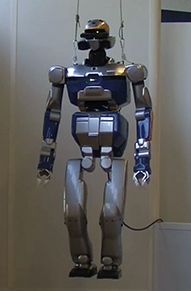
The term "robot" first appeared in 1920 in a science-fiction play by the Czech playwright Karel ?apek. His brother Josef coined it from the Czech word robota, meaning "work." As for "robotics," science-fiction author Isaac Asimov unwittingly coined the term in 1941. He thought it already existed, like "electronics"!
The extraordinary growth of information and communication technologies (ICT) sometimes leads people to think that robotics falls within their scope. It does not. The difference comes down to one word: gravity. A robot is a machine that interacts with gravity—and sometimes with other forces. Robotics is not virtual: it belongs to the physics of the real world.
Robotics uses ICT to serve a great historical tradition: that of building machines. The defining characteristic of a machine is movement. Movement also allows us to classify natural objects into three categories: inert objects, plants and animals. Plants and animals both move, but animals can travel: unlike plants, they do not find everything they need where they are.
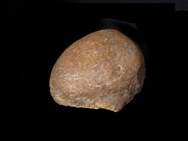
 
Inert objects. Plants. Animals.
Human-made machines can be classified in a similar way into tools, industrial robots and mobile robots.
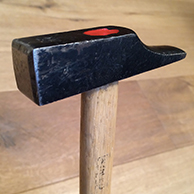
 
Tools Industrial robots Mobile robots
("inert machines"). ("plant-machines"). ("animal-machines").
Robotics is about acting through movement. Because we too interact with gravity, it raises the question of how we move and act. Do we know everything about ourselves? This is what makes robotics so fascinating: it raises questions that reach into mathematics, rhetoric and dance. How does a choreographer talk about movement? How does a choreographer describe a movement to a dancer? This leads to a parallel question: how do you program a robot?
L'Espace et la Géométrie is the title of a famous article by Poincaré (Revue de métaphysique et de morale 3, 1895). Its main lesson is that the words "space" and "geometry" must now be used in the plural.
Poincaré went back to the origins of geometry, showing that movement gave rise to it. Classical geometry is defined by the existence of solid bodies in space. What transformation takes a bottle from the table to the hand holding it a few moments later?
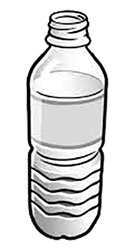

Follow the bottle with your eyes: its shape changes on our retinas, our eye muscles are working, and from this sensory information we understand that something is happening. According to Poincaré, analysing this phenomenon through mechanisms of abstraction leads to the fundamental concepts of geometry. He distinguishes very precisely between two types of space: geometric space—the real world outside us—and representational space, which belongs to us and has three components—visual, tactile and motor—if we leave the other senses aside. Let us follow his reasoning:
> "What geometry studies is a particular 'group'; but the general concept of a group exists beforehand in our minds, at least potentially. It imposes itself upon us not as a form of our sensibility, but as a form of our understanding."
Now that really is mathematics!
> "Yet among all possible groups, we must choose the one that will serve, so to speak, as the standard against which we measure natural phenomena. Experience guides us in this choice but does not impose it upon us; it shows us not which geometry is truest, but which is most convenient."
That sounds like something an engineer would say!
Which geometry should we choose? To explain that three-dimensional spaces can take several possible forms, Poincaré presented several forms of two-dimensional space—the boundary of a three-dimensional object. The skin of an orange, for example, is the orange's boundary. By analogy, a three-dimensional space can be the boundary of a four-dimensional object, and such spaces come in a great variety of forms...
-
Spaces for action
-----------------------
Movement lies at the origin of action, just as it lies at the origin of geometry. Can we conceive of a "geometry of action"? To pick up a glass, we must first grasp it. Our sensory organs allow us to locate it. The body moves towards the glass, the hand reaches out, and then grasps the glass...
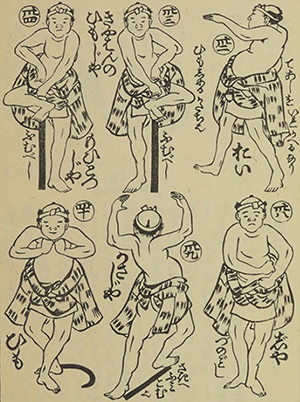
Action takes place in physical space. Sensory space consists of the data supplied by the five human senses, together with the sense of balance, which provides our sense of vertical and is technically located in the vestibular system. Finally, since we have more than seven hundred muscles, our motor space has at least seven hundred dimensions. All these spaces must interact for the action to be performed, with the brain and nervous system managing that interaction.
For a humanoid robot, it works in exactly the same way! It has four cameras, force sensors at its ankles and wrists, gyroscopes and accelerometers, which provide information similar to that supplied by the vestibular system. Its sensory space therefore has a large number of dimensions, just as ours does, while its motor space has as many dimensions as it has joints—that is, angular variables.
A robotics engineer's central task is to calculate the motion needed to perform an action. This motion, so easy to describe—picking up the glass—is extraordinarily complex. It originates in a 700-dimensional space. And Poincaré tells us: "Choose the most convenient geometry!"
-
Calculating motion
----------------------
What links motor space to physical space? Our object, remember, is not rigid: it is articulated and deformable. We must distinguish between two concepts: pose and posture. Pose tells us where an object is located in space, while posture tells us its shape: a body has a shape, its muscles deform it, and every action involves deforming the body.
To represent posture schematically, we use angular variables for the skeleton: the angles between its various segments. These variables are intrinsic to the body. In a robot, we act directly on the angular variables. In an animal, the angles are determined by the tension in the various muscles.
To specify the pose of a human being—or a robot, a wheel, a car and so on—we need only two planar coordinates and an orientation variable. These variables are not directly under our control. We have no motors with which to alter them; we move through space only indirectly, by changing shape.
Borrowed from mechanics, the concept of configuration space encompasses both pose and posture. We calculate motion in this "joint" space, not in physical space.
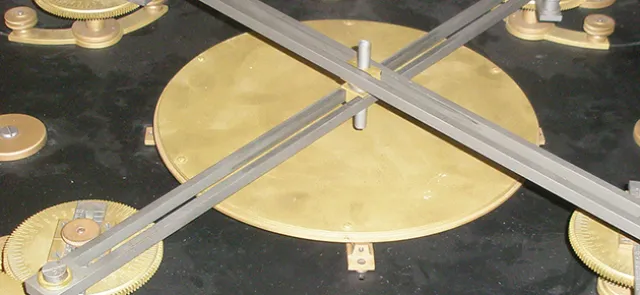
Thus, positioning a system of two bars requires two angles. Its joint space is [0, 2π] × [0, 2π], with 2π identified with 0, as in Pac-Man: leave the screen on the left and you re-enter on the right; leave at the top and you return from below. Geometrically, the opposite sides of the square are identified, producing a torus. We have moved into an ideal, mathematical world: the robot becomes a mere point in this space.
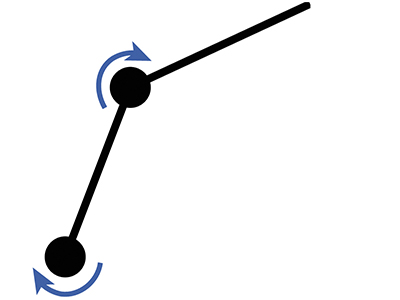
Movement in physical space.
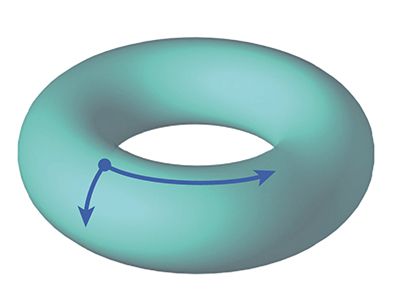
Movement in configuration space.
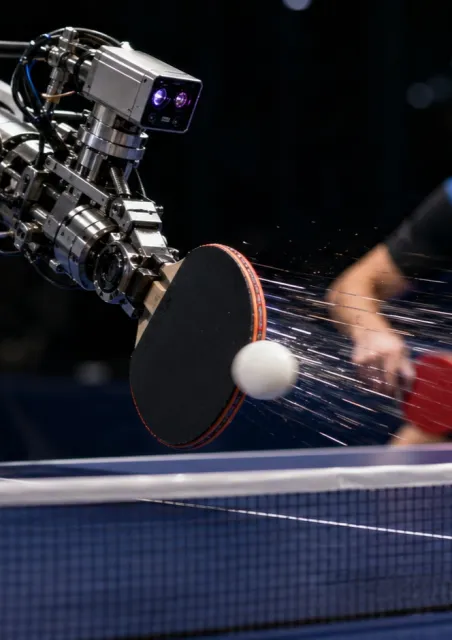
We can set a robot—or, rather, its computer—a difficult task: plan a motion from one position to another while avoiding obstacles. This is the famous piano mover's problem. In configuration space, it becomes the ping-pong-ball mover's problem. Here, the task is to move from position A to position B while avoiding obstacles. The automotive industry works this way: can a seat be fitted into a particular passenger compartment? If a robot is to perform the operation, software is developed to control it.
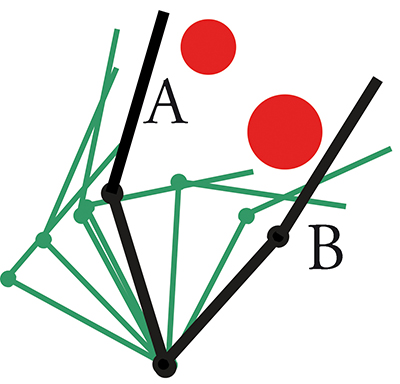
Movement with obstacles (in red) in physical space.
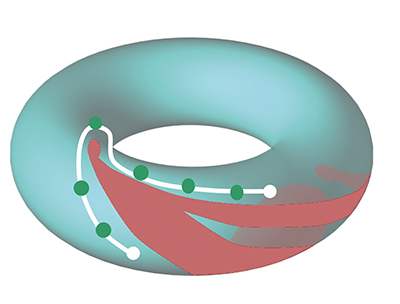
Movement with obstacles (in red)
in configuration space.
How are these calculations performed? To bring an apple to your mouth, you can calculate the x, y and z coordinates of the apple in your hand as functions of your shoulder, elbow and wrist angles, then vary those angles so that the apple moves closer to your face. This is what robotics engineers do in industry. But with dozens of parameters to play with, there are too many possible trajectories. One is singled out by choosing a criterion to optimize. A living organism, by contrast, adopts a sensorimotor approach: it makes the apple's image on the retina grow larger, continually monitoring and correcting the trajectory.
-
Non-holonomy
----------------
If we cannot move through space simply by changing our own configuration variables, how can we move at all? Take a car wheel. It has just one configuration variable: its angle of rotation. The wheel must be on the ground for friction to add translational motion to its rotation. This is a universal phenomenon:
Displacement = changing configuration variables + friction.
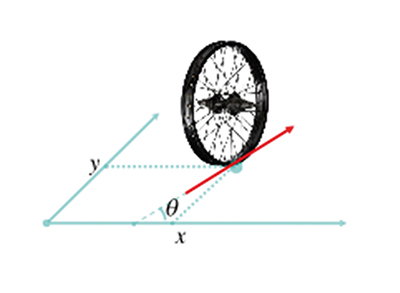
The wheel's configuration is defined by two position coordinates (x, y) and one orientation variable, θ. But not every motion in configuration space is possible: the wheel cannot move sideways, perpendicular to its own plane; it can only roll in the direction it is pointing.
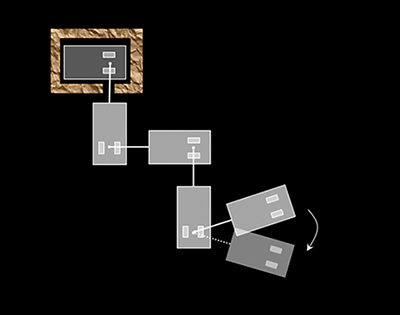
Cart with four trailers.
The infinitesimal motions of the point representing the wheel in configuration space are constrained: they form a two-dimensional space. Yet, starting from any given point, we can reach every point in the three-dimensional configuration space. You know how: by maneuvering! Mathematically, a "maneuver" is an operation of the form "A, then B, then the inverse of A, then the inverse of B."
Turning the steering wheel, moving forward and backward, or combining the two still gives a two-dimensional control space. When there are fewer basic maneuvers than dimensions in the reachable space, the motion is said to be underactuated. The mathematical phenomenon is known as non-holonomy (holonomy is when every path is allowed). A fish swimming and an animal walking are both instances of non-holonomy in shape space.
#### **
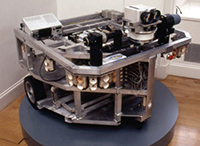
**Hilare, the first French mobile robot, championed by Georges Giralt in the late 1970s.
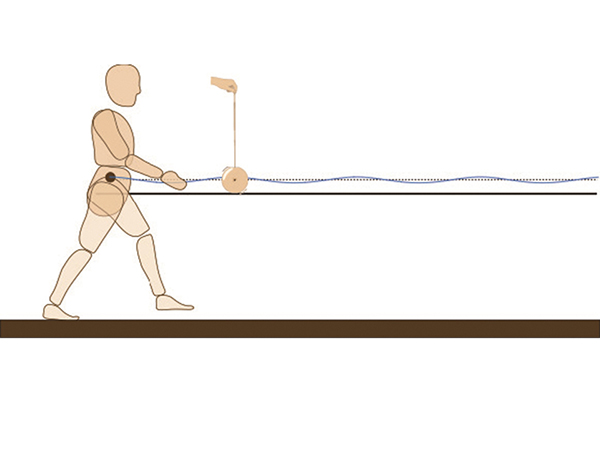
Where are we today? A group of researchers at LAAS is studying human walking—and they have rediscovered… the wheel! A walker's center of gravity traces a hypocycloid with remarkable precision (the curve traced by a point on a wheel that lies neither at its center nor on its rim). This has led to the audacious idea that the brain may only need to control the motion of this virtual wheel—the translation—while leaving the legs' periodic motion to low-level functions…
Interview by A.B.