A life...
----------
Laurent Schwartz (1915–2002) entered the École normale supérieure in 1934, where he met Marie-Hélène Lévy, daughter of the probabilist Paul Levy and herself a mathematician—her research focused on the topology of singular algebraic varieties. They married in 1938 and had two children. During the Second World War, as a Jew and a committed Trotskyist, he was forced into hiding, first in Toulouse and then in Clermont-Ferrand, where he defended his doctoral thesis in 1942.
In mathematics, Laurent Schwartz formalized the theory of distributions, which generalizes the notion of a function. Among other things, this made it possible to model physical phenomena more effectively: many problems involving discontinuities lead to differential equations whose solutions are distributions rather than ordinary functions. This work earned him the prestigious Fields Medal in 1950.
A supporter of decolonization, he denounced the French army's use of torture during the Battle of Algiers and the United States' massive bombing campaign in Vietnam.
A professor at the École polytechnique from 1959 to 1980 and a member of the Académie des sciences, he fostered international cooperation in mathematics by teaching courses in Asia and South America.

... in comic panels...
----------------
In the same series as Les oscillations de Joseph Fourier and Les audaces de Sophie Germain, Petit à petit has published Laurent Schwartz, les engagements d’un médaillé Fields this year.
Alternating comic-strip sequences with documentary sections, the book traces the mathematician's intellectual journey but does not focus solely on mathematics. Laurent Schwartz was also passionate about entomology and, above all, deeply committed to the causes he believed were just. In particular, he campaigned against the use of torture during the Algerian War, signed the Manifesto of the 121—which cost him his position at the École polytechnique—denounced atrocities committed by the US military during the Vietnam War, and opposed the arbitrary detention of scientists by dictatorial regimes...
Besides its valuable historical insights, one of the strengths of this highly accessible documentary graphic novel is that it challenges a common misconception: mathematicians, women and men alike, do not live apart from the world but grapple directly with reality.
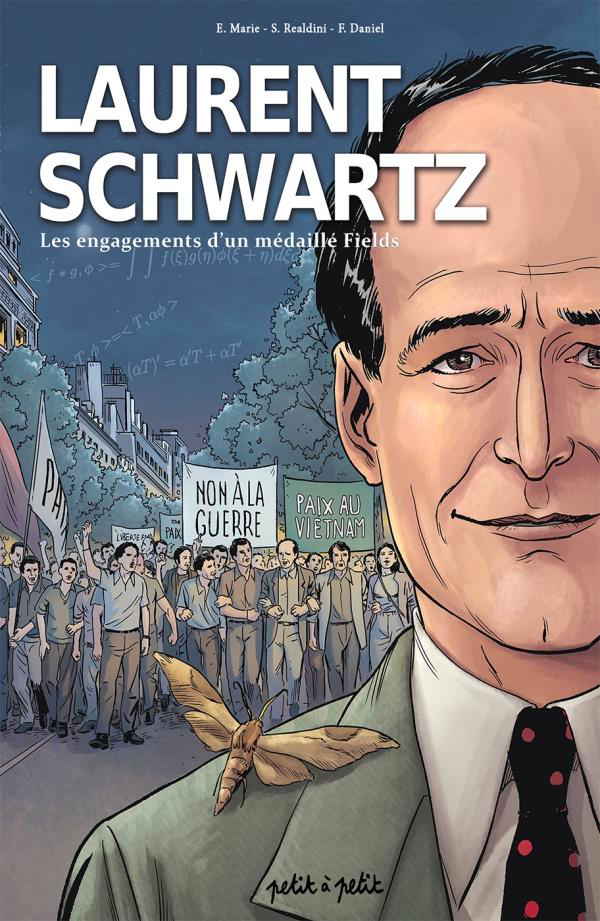
Laurent Schwartz, les engagements d’un médaillé Fields, Emmanuel Marie, Hervé Pajot, Stefano Realdini,
Petit à petit, 64 pages, 2024, €17.90.
... and on film!
----------------
To mark the publication of the graphic novel devoted to Laurent Schwartz, the Institut Fourier (Grenoble) created the exhibition "Laurent Schwartz, des mathématiques à l’engagement politique". It accompanies a fascinating half-hour documentary film (available at **laurentschwartz24.sciencesconf.org*) tracing the intellectual, political and personal journey of this great mathematician. After an introduction drawn from a text in which the mathematician Claudine Schwartz recalls her childhood with her parents, one section offers an excellent popular account of distribution theory, while another explores Laurent Schwartz's passion for butterfly hunting (sic!), a pastime he pursued avidly. In Rugissements*, an excerpt from which is read in the video, he recounts how, while in Venezuela "first to give mathematics lectures and then to hunt butterflies", he found himself face-to-face with a jaguar!
His political battles, particularly in the "Maurice Audin affair", and his efforts to modernize teaching at the École polytechnique are also discussed.