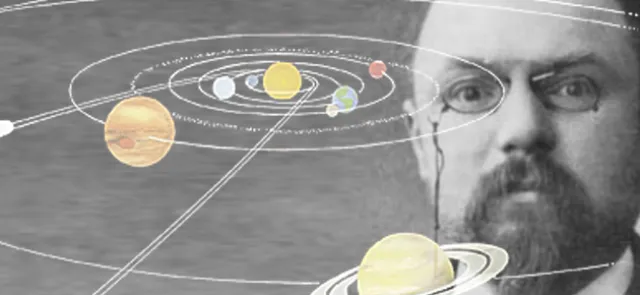
In 1885, European newspapers announce that His Majesty Oscar II, King of Sweden and Norway, has decided to award a prize for an important mathematical discovery. A scientific committee is formed, and four problems are set for the competition, including "the study of the motion of any number of bodies attracting one another according to Newton's law". Entries will be submitted anonymously, and the winner, to be announced on 21 January 1889, the king's sixtieth birthday, will receive a gold medal and 2,500 kronor, a considerable sum at the time. The winning paper will be published in the journal Acta Mathematica, and its author will travel to Stockholm, Sweden, to give a series of lectures on his work.
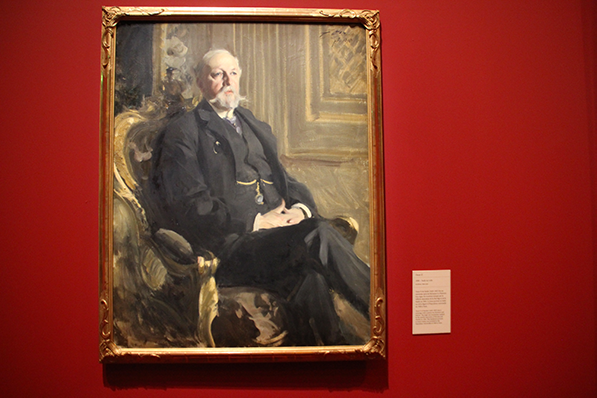
Oscar II, King of Sweden [and Norway]. Anders Zorn, 1898.
The king's prize
When the day came, the prize went to Henri Poincaré, a 35-year-old French mathematician who immediately became a national hero. And with good reason. The Nobel Prizes did not yet exist, nor did the Olympic Games, and after the loss of Alsace-Lorraine, there was intense rivalry between France and Germany, the two leading mathematical nations. King Oscar II's prize was rather like a football World Cup final: although no crowds flooded the Champs-Élysées, the French press had a field day. Then attention moved elsewhere, the paper appeared in November 1890, and Poincaré continued his brilliant scientific career.