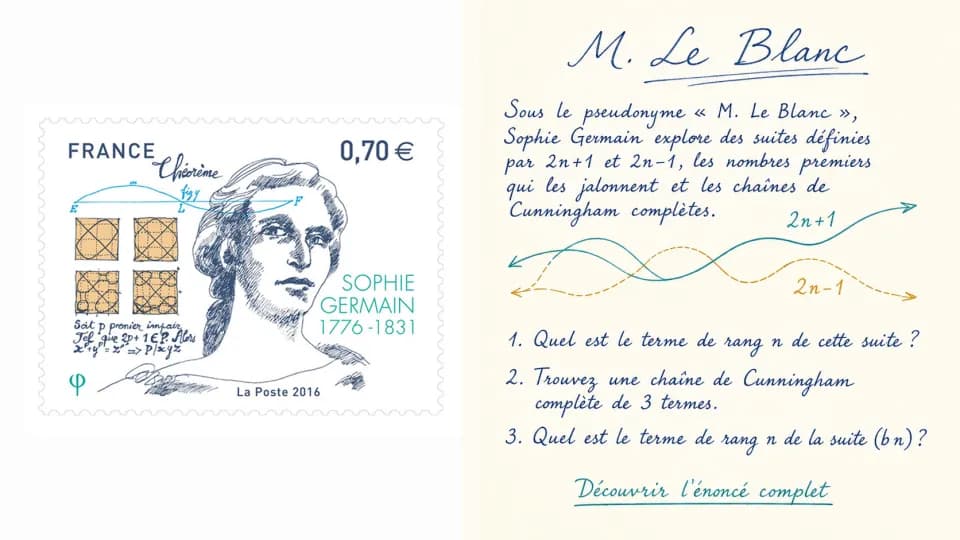
Voici la suite de nombres (an ), dans laquelle les nombres premiers apparaissent en gras : 2 ; 5 ; 11 ; 23 ; 47 ; 95 ; 191 ; 383 ; 767 ; 1535 ; 3071 ; 6143 ; 12287…
Cette suite est toute simple : on part du nombre 2, qui est le plus petit des nombres premiers (et le seul qui soit pair), on multiplie par 2 puis on ajoute 1. On itère ensuite le procédé.
1. Quel est le terme de rang n de cette suite ?
On remarque immédiatement que la suite des chiffres des unités est périodique à partir du second terme, ce qui découle de la méthode de construction. Il en résulte que tous les termes d’indice n = 4k + 2 seront des multiples de 5, donc non premiers à l’exception de 5.
Qu’en est-il des autres termes ? Ils sont premiers jusqu’à 383, mais cela ne perdure pas ensuite. En effet 767 = 13 × 59 ; 3071 = 37 × 83 ; 12287 = 11 × 1117...
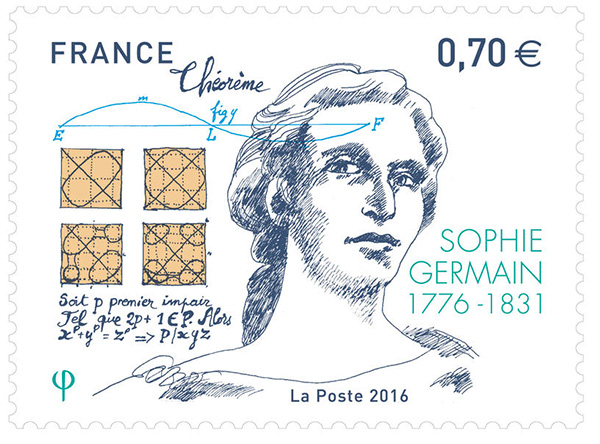
Sophie Germain, comme tous les mathématiciens de son époque, était fascinée par le grand théorème de Fermat, démontré dans certains cas particuliers, mais dont la démonstration générale échappait encore à tous.
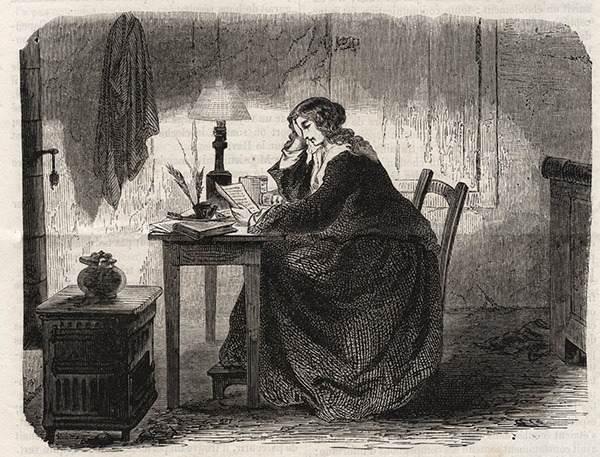
Elle s’intéressa alors au cas où, dans l’égalité de Fermat x p + y p = z p, l’exposant p (p > 2) est un nombre premier tel que 2p + 1 est également un nombre premier, et démontra que, dans un tel cas, il n’y avait pas de solutions. On appelle aujourd’hui ces nombres les nombres premiers de Sophie Germain, dont voici les premiers termes : 2 ; 3 ; 5 ; 11 ; 23 ; 29 ; 41 ; 53 ; 83 ; 89 ; 113 ; 131 ; 173 ; 179 ; 191 ; 233 ; ...
On conjecture qu’il existe une infinité de nombres premiers de Sophie Germain, mais cela n’a pas encore pu être démontré.
Des chaînes de nombres
Le mathématicien indo-britannique Allan Cunningham (1842-1928) s’intéressa à ces nombres et aux chaînes complètes de plusieurs nombres premiers, constituées de suites de nombres premiers de Sophie Germain, à l’exception du dernier terme qui n’a pas de successeur premier, telles que 2 ⇒ 5 ⇒ 11 ⇒ 23 ⇒ 47 par exemple. Le plus longue chaîne actuellement connue comporte seize nombres dont le premier est 810433818265726529159.
2. Trouvez une chaîne de Cunningham complète de 3 termes.
On définit aussi des chaînes de Cunningham de seconde espèce à partir des suites de nombres premiers de la forme
n ⇒ 2n − 1 ⇒ …
(bn ) : 2 ; 3 ; 7 ; 13 ; 25 ; 49 ; 97 ; 193 ; 385 ; 769 ; 1537 ; 3073 ; 6145 ; 12289 ; ...
(les nombres premiers sont en gras dans cette liste).
3. Quel est le terme de rang n de la suite (bn ) ?
La plus longue chaîne de seconde espèce actuellement connue comporte seize nombres dont le premier est 3203000719597029781.
On peut aussi rechercher des chaînes de Cunningham généralisées du type p ⇒ kp + m ⇒ ..., où k et m sont des entiers naturels, et p et kp + m des nombres premiers.