



It began as no more than a puzzle posed on the sidelines of the 1977 International Mathematical Olympiad, held that year in Belgrade, Yugoslavia. But its origins may go back further. Here is the problem as it was posed:
1,
11,
21,
1211,
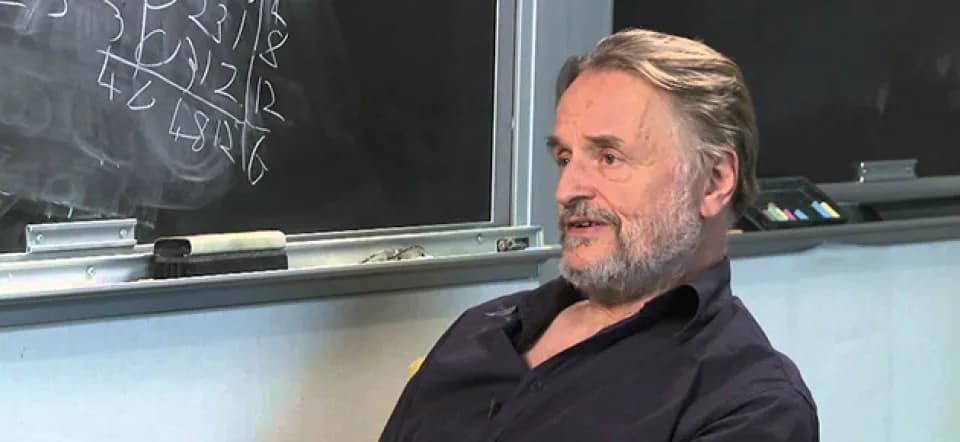
Self-describing sequences are fairly well known among mathematics enthusiasts, but their history often is not. Even less familiar, no doubt, is the work of the man who helped bring them into the mathematical mainstream: John Conway, who devoted his life to having fun with mathematics.
It began as no more than a puzzle posed on the sidelines of the 1977 International Mathematical Olympiad, held that year in Belgrade, Yugoslavia. But its origins may go back further. Here is the problem as it was posed:
1,
11,
21,
1211,
Articles recommended for you.

Founded in 1995 by British-American Neil Sloane, the OEIS (On-Line Encyclopedia of Integer Sequences) is a collaborative website where anyone can add a new way of generating a sequence of numbers, together with its known properties and the questions it raises. Nearly 400,000 sequences can be browsed there!
Algebraic numbers that count...
These numbers, which can be read equally well from left to right or from right to left, raise questions. At first glance they seem highly unusual, and therefore rare. Yet when an elementary arithmetic process is repeated on any whole number whatsoever, we almost always end up with just such a number. Bizarre, how bizarre!
What use is there in raising numbers to powers, except for the fun of uncovering some arithmetical property of the natural numbers? Unexpectedly, this ancient computational art lies at the heart of modern cryptography and secure data transmission.
Discussion
Sign in to post a comment and talk with other readers.
No comments yet. Be the first to respond.