A nice surprise among the prime numbers
----------------------------------------
We thought we knew everything about the distribution of prime numbers—well, no! A preprint from March 11, 2016 reveals a surprising property of these famous integers, which have no divisors other than themselves and one. Its authors, Robert Lemke Oliver and Kannan Soundararajan, both from Stanford University (California, United States), studied the remainders in the division by q (especially for q = 10) of pairs of consecutive prime numbers. Astonishingly, prime numbers have well-defined preferences regarding the last digits of the prime numbers that follow them.
Their approach was initially experimental and statistical: for example, among the first billion prime numbers, a prime number ending in 9 is 65% more likely to be followed by another ending in 1 than by another prime number ending in 9. In other words, prime numbers repel successors ending in the same last digit, and the researchers have presented theoretical proofs of their results, currently under review. It all happens as if the distribution of prime numbers were biased. This is, moreover, somewhat reminiscent of the "Chebyshev bias," which the Russian mathematician formulated in 1853: "Most of the time, there are more prime numbers of the form 4k + 3 than 4k + 1, beyond a certain limit." Here too, a new avenue has just opened…
A short story dedicated to Wiles
---------------------------
One might be tempted to say that this has nothing to do with Fermat's "last" theorem, apart from the title, The Best Fermat Theorem, but this short story, published in 1995 by American science-fiction author Janet Kagan, who died in 2008, has an original twist tied to the famous theorem. It turns out that some of the characters belong to a very exclusive club, the Marginalia. This term, incidentally, refers to the notes a reader or copyist might write in the margin of a work, exactly as Fermat himself had done, scribbling in the margin of his copy of Diophantus's Arithmetica. The originality, however, lies elsewhere: this club, which admits members by invitation only, is made up of seven of the most important living mathematicians. And how does one become a member? The club's motto might put you on the right track: "I know how to solve it." Solve what? Fermat's theorem, of course!
And yes, the Marginalia is the club of those who know how to solve this theorem but pledge not to publish their proof, meaning that for the next person to solve Fermat's last theorem, it will be as if they were the first! Janet Kagan had dedicated her short story to Sir Andrew Wiles, "with a broad smile."
Andrew Wiles: the prize of a lifetime
--------------------------------
The Norwegian Academy of Science and Letters awarded the 2016 Abel Prize to Sir Andrew Wiles, of the University of Oxford, for having "spectacularly proved Fermat's last theorem by way of the modularity conjecture for semistable elliptic curves, thereby opening a new era in number theory." That is how the president of this venerable academy announced the winner of the richly endowed Abel Prize, in Oslo on March 15.
For Andrew Wiles, this prize rewards the work of a lifetime. Having discovered a book on Fermat's last theorem at the age of 10, Wiles never let go of this mathematical puzzle… until that day in 1993 when he announced his discovery to an admiring audience at a seminar in Cambridge. The celebration was short-lived, for his proof had a flaw, but no matter: Wiles got back to work, corrected his proof, simplified it, and this time, glory was his!
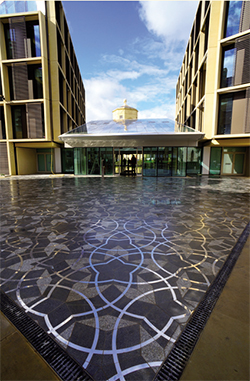
The Andrew Wiles Building at Oxford.
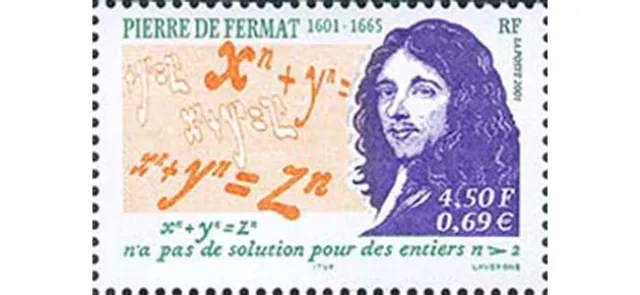
Never had a mathematician made international headlines to such an extent. Just think: a theorem that people had been trying to prove for three and a half centuries, yet with such a simple statement: if n is a natural number greater than 3, the equation *xn + yn = zn* has no integer solution in strictly positive numbers. Wiles worked on it for nearly eight years, alone and often in secret. Along the way, he opened up new paths for mathematics, developing innovative ideas and techniques.
Andrew Wiles now works at Oxford, at the "Andrew Wiles Building," opened in 2013 and named in his honor.