The art world is punctuated by movements, some of them short-lived. The Concrete Art movement can be disconcerting because of its wide range of approaches and the apparent lack of unity in the artists' methods.
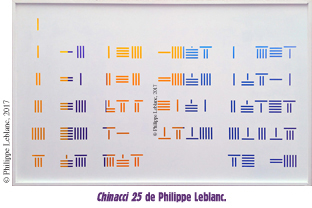
A mathematical reading, however, can help bring that unity to light and clarify what makes the works "concrete." To illustrate this, consider Denise Demaret-Pranville, a visual artist well known to readers of Tangente, and the Belgian artist Philippe Leblanc (their websites are easy to find by adding the word "art" to their names in an Internet search). Philippe Leblanc's Chinacci 25, whose very title is enigmatic, will serve as our guide.
From China to the Americas
Reading the work Chinacci 25 (opposite) column by column, a mathematician is immediately struck by the pattern in the first few terms: 1, 1, 2, 3, 5. Each number is the sum of the previous two. The next can readily be interpreted as an 8. The work in fact uses a system for writing numbers that was invented in China several centuries before the Common Era. At the time, the Chinese counted with rods rather than abacuses, which they adopted later. This led them to devise a way of writing numbers. They used two forms of notation, alternating between them to avoid confusion among units, tens, hundreds…