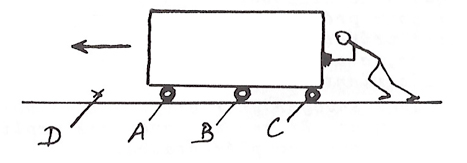
When you need to move a large, heavy object, such as a chest, across a roughly horizontal floor, placing "rollers" between the floor and the object makes the task much easier. As the diagram shows, several rollers—A, B, C, and so on—are needed. When the chest moves in the direction of the arrow, roller C rolls out behind it: someone must retrieve the roller and place it in front of the chest, near D.
Rollers that do not roll
=====================================================================================================================================
Rollers reduce the effort needed to move the chest, but they have one drawback: they roll very easily if the floor slopes… How could we make rollers that allow a chest to be moved with minimal effort but do not roll away by themselves on a slope? The next figure suggests a "roller with a triangular cross-section," which certainly will not roll by itself. The trouble is that if a chest is placed on point C and pushed, either it must slide over point C—which is just as hard as if the chest were resting directly on the floor—or the "roller" must tip by pivoting about B. But this is very difficult, since the chest has to "rise" from C to C'.
In fact, it does not "roll" at all! An equilateral triangle therefore cannot serve as a roller. But there is nothing to stop us from trying to improve it.