Tangente: What motivated you to design your book in the form of an almanac, a format rather unusual for the sciences?**
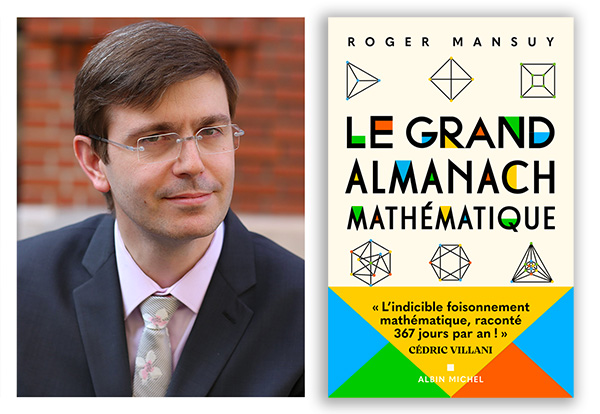
Roger Mansuy: The almanac format wasn't part of the original plan. It started with the wish to show that we often have too narrow a view of mathematics. We obviously see the exercises and theorems, the great theoretical edifices, the applications… but we forget that mathematics is, more broadly, a culture that permeates a great many human activities, from literary or artistic creation to sports, from history to politics… To convey an understanding of all these traces in our societies, we needed to find a format that was easy to digest. With Christian Counillon, editorial director for "Sciences" at Albin Michel, we considered various possibilities before arriving at the idea of an almanac; while the format may seem unusual for popular science, it is well established and lets interested readers read one page a day… or devour the whole book at once. As an author, it also lets me change subject quickly and so tackle very different themes without much constraint.
How did you select the mathematical facts, figures and anecdotes that punctuate the 365 (or even more!) days of the year?
Let's start with the easiest part of the question: there are 367 dates. We wanted the book to be readable as an almanac regardless of the year (leap or not), so we had planned for 366 dates — until we learned that the kingdom of Sweden had had a year with two leap days, in 1712. This gave us a pretext for adding the unusual date of 30 February.
Each day tells a "story": some are very light, even funny, others carry more mathematical or historical weight. Many have rarely been told, and the first readers admitted to me that they were surprised, even on subjects they had mastered — surely one of the finest compliments, don't you think?
Is there a common thread or an overall logic behind this abundance?
There is no common thread and no recommended reading order: readers can easily start with their own birthday and continue at random. The book was written so that each page stands independently of the others yet is tied to the date on which it falls: 14 February deals with Valentine's Day; 30 March with the death of the mathematician Laura Pisati; 26 April with the patent for the Nimatron; 8 July with the baptism of Jean de la Fontaine; 22 October with the worst defeat of the French national football team (in 1908)… but all these subjects lead back to mathematics, a sign that there is much to gain from taking an interest in it in order to look more closely at the world.
You made the strong choice of devoting more than a hundred entries to women mathematicians. Is this an activist gesture, a pedagogical one, a symbolic one… or all of these at once? Was it easy to find so many women mathematicians?
To show the cultural richness of mathematics, we of course had to look at the community of people who practise it, whether professionally or as a pastime. But as soon as you look at this small world, you realize how diverse it is. The background research that preceded the writing quickly turned up more subjects involving women mathematicians than this book needed. We then had to choose which ones to keep, and it was not very difficult to include numerous entries in the almanac featuring women mathematicians. To answer the question more directly, it is undeniably an act of activism in the face of gender bias in our society… but, as an author, it is also a stroke of luck, since it provides many interesting subjects rarely covered in popular science, such as the stories of Irene Stegun, Wang Zhenyi, Tatiana Erhenfest, Elizebeth Friedman or Marie Crous…
To be honest, that's not the only editorial choice at work: I also wanted to show that mathematics is not just a European affair, that people practise mathematics outside universities or schools, and that people can do mathematics while being fully engaged with society and the causes of their own time.
I hope I have risen to the challenge of showing the human richness of our community (but also its flaws and its excesses) without coming across as sanctimonious or preachy.
Does your experience as a mathematics teacher influence the way you write about mathematics?
Anyone who teaches knows they must hold the students' attention, or know how to win it back. You could assume this plays a part in how you write a popular-mathematics text; however, I have the feeling that this almanac drew more on the encounters around talks in middle schools, high schools, media libraries, municipal halls… The audiences who attend these events always come with a good frame of mind, an openness and a curiosity that are a pleasure to see… but also with trick questions and queries that force you to think as much about the content of the talks as about how to present them. I often thought of some of these exchanges while writing this book, and I am convinced that certain people will recognize it as a continuation of our informal discussions.
Did you want to make a book only for people who already love maths and want to learn more, or also for everyone else?
Any curious person can find this book interesting and find food for thought or enthusiasm in it; since the main message was to show how mathematics is present in general culture, it would have been ill-advised to address only "experts". At the same time, I wanted someone with a more substantial mathematical background to find something worthwhile in it too. I had to juggle accessibility with touching on a few more advanced subjects, and to allow, in places, several levels of reading. I would be delighted to hear back from readers of different backgrounds.
More generally, what do you think mathematics tells us, beyond the figures and the equations?
The question is vast, so let me take a step sideways. Cooking is not limited to the dishes of a Michelin-starred chef or to recipe books; cooking is also the meal you throw together quickly after getting home from work, the little guilty pleasure you allow yourself despite the diet, the moments spent cooking together, the sharing around a table, the memories of grandmother's cake, the cookery competition shows on television, the Tontons flingueurs (from the French film of that name) buttering their toast, the technique for properly peeling peppers, the carefully studied menus of athletes, the exoticism of the local gastronomy on a trip, and much more besides… It is undeniable that cooking appears as a culture, one that cannot be reduced to just a few of its elements. Well, in my view, mathematics has the same status, and, taken as a whole, it too tells a multitude of lives and human experiences. In fact, I dream that everyone might be able to testify to the part mathematics plays in their own life, so that we might discover the variety of interests and appreciations, the diversity of practices, and the richness of the sensations it provides.
Interview conducted by Antoine Houlou-Garcia
[
](https://www.librairie-infinimath.com/products/le-grand-almanach-mathematique-roger-mansuy-auteur?_pos=1&_sid=892abdc07&_ss=r)