Isometries preserve lengths. Yet it is easy to imagine a transformation that preserves the shape of objects without necessarily preserving their size. That is what happens in the diagram, for example: the portrait of Carl Friedrich Gauss remains similar, but is rotated slightly and resized.
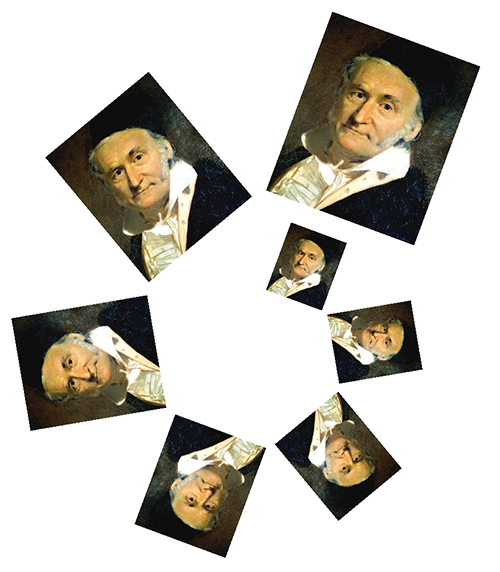
We can even imagine combining changes in size with reflections, as in the portrait of the famous milkmaid below.
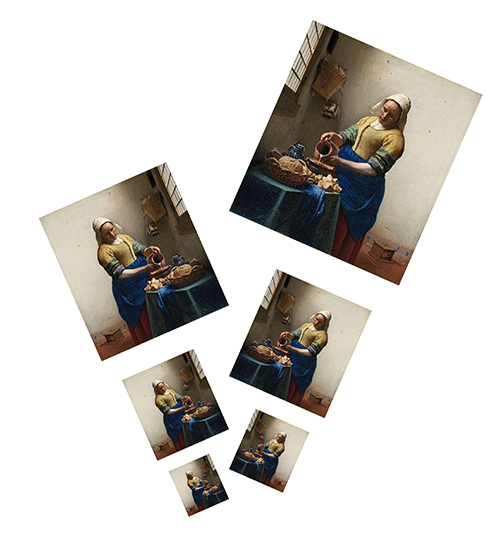
All these maps take a figure to a similar figure. Put less prosaically, they preserve ratios of distances—or, equivalently, multiply every distance by the same positive number k. Geometers call these geometric transformations similarities. In fact, each is a composition of an isometry and a dilation with scale factor k: a reduction (if k lies between 0 and 1) or an enlargement (if k is greater than 1). If the figures are not reflected (as with the portrait of Gauss), the similarity is said to be direct; otherwise, it is said to be indirect.